25 Solar Eclipse Facts That Will Blow Your Mind
iStock
Many of already have April 8 marked on our calendars this year, as we prepare for one of nature’s most fascinating phenomena : a total solar eclipse. This occurs when the Moon passes between the Sun and the Earth, completely blocking the Sun’s light and causing the Moon’s shadow to sweep across the planet. According to NASA, it is estimated that 31.6 million people throughout North America will be able to see next month’s total solar eclipse—making it quite a spectacle for such a rare event. You don’t want to miss it—the next one you’ll be able to see from the U.S. will be in 2044—but while you’re waiting, check out these 25 fascinating solar eclipse facts.
RELATED: What Really Happens to Your Eyes If You Look Directly at a Solar Eclipse .

Shutterstock
You’ve almost certainly used helium to blow up balloons. But did you know you have solar eclipses to thank for the discovery of this natural element?
French astronomer Pierre Janssen was the first person to observe helium (even before it was named as such) during a total eclipse that passed over Guntur, India, on Aug. 18, 1868, according to the American Physical Society (APS).

Shutterstock
Discoveries during solar eclipses haven’t stopped. During the last total solar eclipse that hit the U.S. in 2017, over 400 scientists set up monitoring stations to determine how bees behave amid this natural phenomenon. Their research, which was published in the Annals of the Entomological Society of America , revealed that almost all bees stop flying and go completely silent during a total eclipse.
“We had not expected that the change would be so abrupt, that bees would continue flying up until totality and only then stop, completely,” lead researcher Candace Galen , PhD, professor of biological sciences at the University of Missouri, said in a statement . “It was like ‘lights out’ at summer camp! That surprised us.”

Javi Guerrero Photo/Shutterstock
Solar eclipses don’t just affect bees. This type of event tends to confuse a lot of animals—especially those that are normally nocturnal, like most owls.
Kate Russo , a 44-year-old author, psychologist and eclipse chaser who has seen 10 total solar eclipses, told Mic that you may be able to “hear owls hooting” during a total solar eclipse.
“They act like it’s nighttime and, when it all stops, they act like it’s daytime all over again,” she explained.
RELATED: 81 Weird Animal Facts Everyone Should Know .

Shutterstock
The relatively unknown college town of Carbondale, Illinois, has been dubbed the “Solar Eclipse Crossroads of America” for a special reason. This is the only city in the U.S. that was in the path of totality for the last total solar eclipse in 2017 that will also find itself in the path of totality for the next total eclipse this April, according to LiveScience.
Shutterstock
Total solar eclipses are often referred to as “rare” events—and while that’s relatively true, they are not the rarest type of solar eclipse out there. That title belongs to the hybrid solar eclipse , per the National Weather Service (NWS).
As EarthSky explains , a hybrid eclipse is a type of solar eclipse that either looks like an annular solar eclipse or a total solar eclipse depending on where someone is looking at it along the central eclipse path. But it only happens roughly once per decade, because both the Moon and Sun’s distance to Earth have to be just right for this hybrid phenomenon to occur.
RELATED: 8 Best Destinations for the Next (and Rare) Total Solar Eclipse .

iStock
While many people now travel just for a chance to see a solar eclipse, this natural phenomenon didn’t elicit the same kind of excitement back in the day. In ancient Greece, people thought solar eclipses were a bad omen , and a sign that the gods were angry.
The word “eclipse” itself actually comes from the Greek word “ekleipsis,” which means “being abandoned,” according to experts at the University of Dallas.

iStock
This ancient belief was actually able to bring a five-year war to an end. Greek historian Herodotus reported that a total solar eclipse on May 28, 585 B.C., created an unexpected ceasefire between the Lydians and the Medes who had been fighting for control of Anatolia (modern-day Turkey), according to the History Channel.
The soldiers interpreted the eclipse—which occurred during the Battle of Halys—as a sign that the gods wanted their conflict to end, so they withdrew their weapons and negotiated a truce.

iStock
You might have to change your radio station or pull out a physical map during a solar eclipse. This event can cause ionospheric anomalies that may “disrupt radio signals and GPS navigation systems, affecting communication and navigation over the affected regions,” NASA explains.
iStock / rodehi
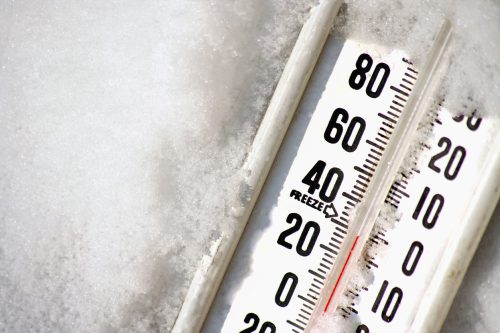
No matter how warm it may be on the day of a solar eclipse, the sudden disappearance of the Sun typically causes a drop in the temperature. In fact, retired weatherman and meteorologist Gib Brown recently told the Adirondack Explorer that he believes the next total eclipse could trigger a decline by as much as 10 degrees.
“I’m thinking that we’ll see something that we can measure, something that may be relatively dramatic,” Brown said. “But beyond just the few minutes or so of the eclipse, the temperatures should rebound fairly quickly as the eclipse goes by.”
RELATED: 54 Hilarious and Random Facts You’ll Want to Tell Your Friends .

Shutterstock
While solar eclipses have been connected to history in many ways, the most famous total solar eclipse in history occurred in 1133, according to NASA’s website.
King Henry I of England died during the event that lasted over four minutes on Aug. 2 of that year. Referred to as the “hideous darkness agitated the hearts of men,” this eclipse kickstarted a massive civil war, as the country fought over the throne.

Shutterstock
At least two solar eclipses happen somewhere on Earth every year, according to NASA. But did you know that there is also a maximum number of solar eclipses that can occur annually as well? Whether partial, annular, total, or hybrid, there can only be five solar eclipses each year.

iStock
Curious about how colors change during solar eclipses? Local Cleveland astronomer Jay Reynolds told WJW that various “odd visual effects” can occur both before and after a total solar eclipse, and that includes a clear shift in color saturation.
“For instance, colors like red will lose their brilliance and appear faded,” he said.
RELATED: Why You Shouldn’t Wear Black, White, or Gray During the Eclipse, Science Says .
aeonWAVE / Shutterstock
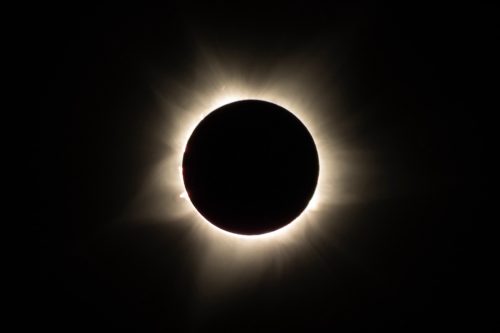
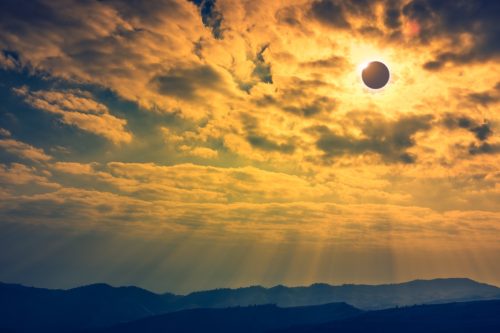
A total solar eclipse can last anywhere from 10 seconds to about 7.5 minutes, according to NASA. The longest totality on record so far occurred on June 15, 743 B.C., and lasted for 7 minutes and 28 seconds.
The next total solar eclipse expected to break this record won’t come until July 16, 2186, when the totality will last for 7 minutes and 29 seconds.
Shutterstock
On the other hand, the shortest total solar eclipse on record didn’t even break the purported totality minimum. This happened on Feb. 3, 919, when totality lasted for a mere 9 seconds.
Shutterstock
Solar eclipses have created a phenomenon called “eclipse chasing,” where people will travel around the world just to try to catch these rare events. Unfortunately, one notable eclipse chaser found fame for how unlucky he was.
Canadian astronomer and professor J.W. Campbell , who wrote a textbook about predicting eclipses, traveled for more than 50 years on expeditions centered around seeing 12 different solar eclipses, LiveScience reported. But it is said that he ended up running into overcast weather each time, experiencing cloudy skies instead of any eclipse.

Shutterstock
While overcast skies are certainly a real concern during solar eclipses, you can count on one type of cloud to move out of the way.
New research published in the Communications Earth & Environment journal showed that cumulus clouds start disappearing when just 15 percent of the Sun gets covered, and they stay away until the eclipse is over.
RELATED: 40 Ocean Facts That Will Blow You Out of the Water .
Vadim Sadovski/Shutterstock
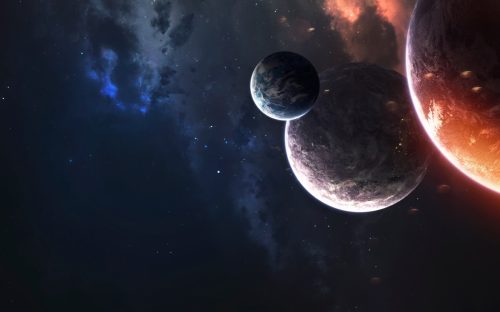
Some people claim that Earth is the only planet that has solar eclipses. But that’s not true. Other planets in the solar system can experience this natural event , and scientists say that some planets’ eclipses, like those on Saturn, may be able to rival those we see on Earth.

Shutterstock
Solar eclipses don’t just cover the Sun’s light and bring down temperatures. They can also mess with the wind , slowing it down and causing it to change direction entirely, according to EarthSky.
Shutterstock
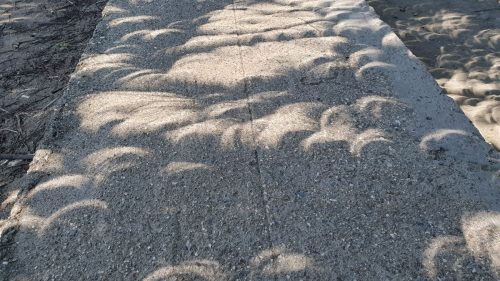
Another weird impact from solar eclipses is a phenomenon known as shadow bands . Sometimes referred to as “snake shadows,” these are “thin wavy lines of alternating light and dark that can be seen moving and undulating in parallel on plain-coloured surfaces immediately before and after a total solar eclipse,” according to NASA.

divedog / Shutterstock
It’s not always easy to see solar eclipses, even if you’re able to travel as an “eclipse chaser.” Since two-thirds of Earth is made up of water, many eclipses end up occurring over the ocean and away from actual human visibility, according to the National Solar Observatory (NSO).
Shutterstock
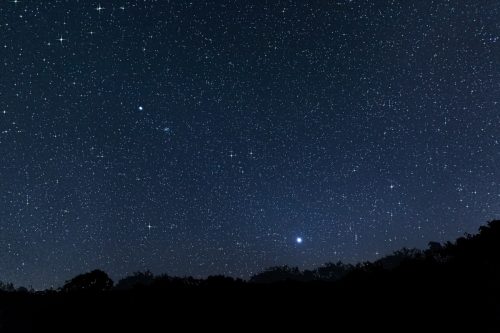
The darkness brought on by a total solar eclipse may bring out the brightness of other stars and planets in the sky. For instance, during the 2017 event, people could see four planets with their naked eyes near the eclipsed Sun: Venus, Jupiter, Mars, and Mercury.
Mercury, Venus, and potentially Jupiter could be visible during the April 8 eclipse, per Great American Eclipse.
Shutterstock
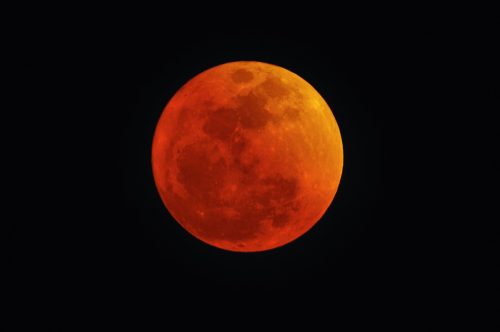
A lunar eclipse is set to happen in late March, shortly before the solar eclipse. That’s because solar and lunar eclipses always come in pairs , according to EarthSky. One usually follows the other within about two weeks, and sometimes, three eclipses can occur in one eclipse season.
RELATED: 39 Facts About Storms That Will Make You Run for Cover .
Lost_in_the_Midwest/Shutterstock
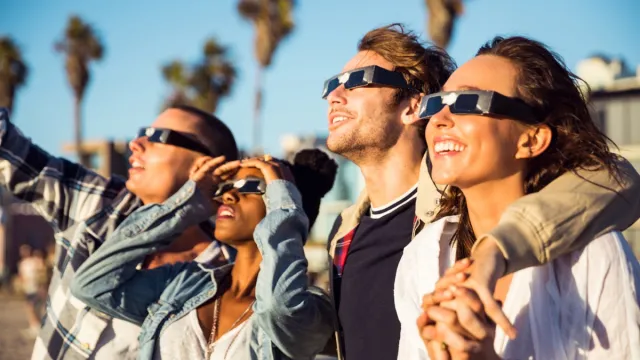
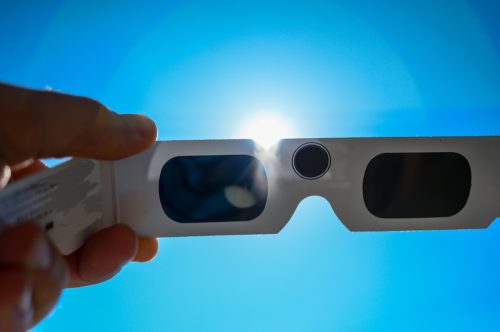
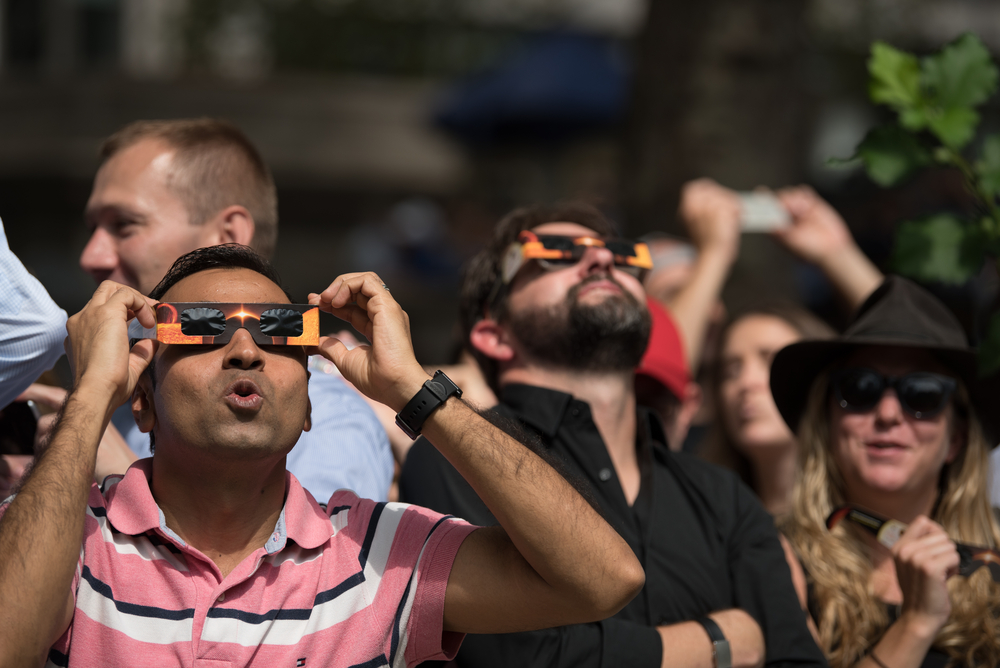
Experts are serious when it comes to their guidance about wearing protective glasses when trying to look at a solar eclipse. You might think their advice is a exaggerated, but you can actually go blind if you try looking at the Sun directly at any moment other than the brief period of totality.
In a Reddit thread , NASA astronomer Bill Cooke , PhD, warned others about his own mistake during a solar eclipse.
“You should never look at the sun without protection! You can damage your eyes without feeling pain,” he wrote. “I know because I have a scar on my retina from not getting my eye protection back on at the end of totality during the 1979 eclipse. Please don’t follow my example!”

Shutterstock
Albert Einstein published his theory of general relativity in 1915, but many scientists remained skeptical about it until two years later.
In 1919, two team of astronomers set out to test Einstein’s theory during a total solar eclipse. After several months of analysis, they revealed that their findings verified the theory of general relativity, making Einstein a science celebrity, according to Britannica.
Shutterstock
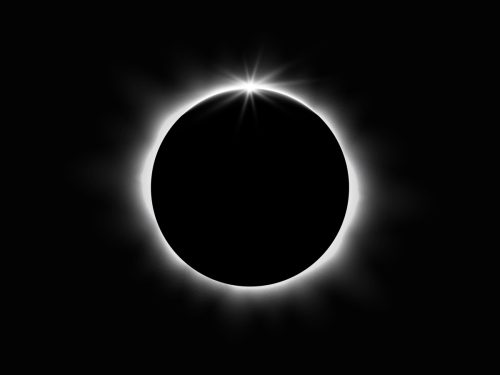
From ending a war to the discovery of helium to Einstein’s celebrity status, total solar eclipses have changed history in more ways than most people realize. But one day, this natural phenomenon will be a thing of the past.
As NASA explains, the Moon has slowly been drifting farther away from the Earth, at a rate of about 1.5 inches per year. Once it passes 14,600 miles, it will no longer appear big enough from Earth to cover the Sun.
Of course, we’ll be long gone before then happens: Experts say it’ll take another 600 million or more years before the planet will no longer experience total solar eclipses.
- Source: NASA: How the 2024 Total Solar Eclipse Is Different than the 2017 Eclipse
- Source: APS: August 18 and October 20, 1868: Discovery of Helium
- Source: Pollination on the Dark Side: Acoustic Monitoring Reveals Impacts of a Total Solar Eclipse on Flight Behavior and Activity Schedule of Foraging Bees
- Source: NWS: Solar and Lunar Eclipses
- Source: NASA: The Impact of Solar Eclipses on the Structure and Dynamics of Earth’s Upper Atmosphere
- Source: NASA: Eclipse 101
- Source: NASA: Eclipse in a Different Light
- Source: NASA: Eclipses: Frequently Asked Questions
- Source: Communications Earth & Environment: Clouds dissipate quickly during solar eclipses as the land surface cools
- Source: NASA: Exploring Shadow Bands
- Source: NSO: Eclipse Science
- Source: CESAR: Solar Observatory
- Source: NASA: Eclipses
8 Best Destinations for the Next (and Rare) Total Solar Eclipse
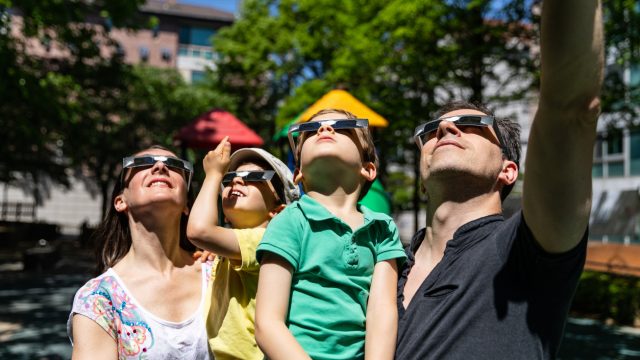
LeoPatrizi/iStock
The chance to witness a total solar eclipse is rare enough that it remains a bucket list item for many people. After all, these events require a combination of being in the right place at the right time and having the correct conditions to actually see them. Since the next eclipse will be the last visible from North America until 2044 , many are making plans well ahead of the event on Apr. 8, 2024, to secure front-row seats.
The hype has created a mad dash for accommodations in locations along the path of totality , which will start in Texas and run across 13 states through Maine, according to NASA. In some places, basic hotel rooms are going for five to seven times their typical rates—including some listed well above $1,000 for a night, The New York Times reports.
The pinch is even being felt in the short-term home rental market, with some avid eclipse chasers saying supply has been dwindling even months in advance. Others reported finding decent rates, only to have hosts cancel their reservations and demand a higher price point for the occasion, The Times reports.
Some experts have recommended finding lodging within an hour’s drive of the path of totality to avoid a price crunch. But others still warn that the expected crowds will likely bring traffic jams along with them on the big day.
“It’s a little bit like going to a big sporting event where people take their time getting in but everybody wants to leave at the same time,” Scott Katsinas , a travel adviser at Katsinas Travel Consultants in Arizona, told The Times .
But even as accommodations run thin in some places, there’s still hope for those who want to experience the event for themselves. Local tourism boards have collected resources for eclipse chasers with options along the path of totality for the big day. Read on for the best destinations for watching the next total solar eclipse in 2024.
RELATED: Southwest Says You Can View the Total Solar Eclipse on These 8 Flights .
Shutterstock / Mihai_Andritoiu
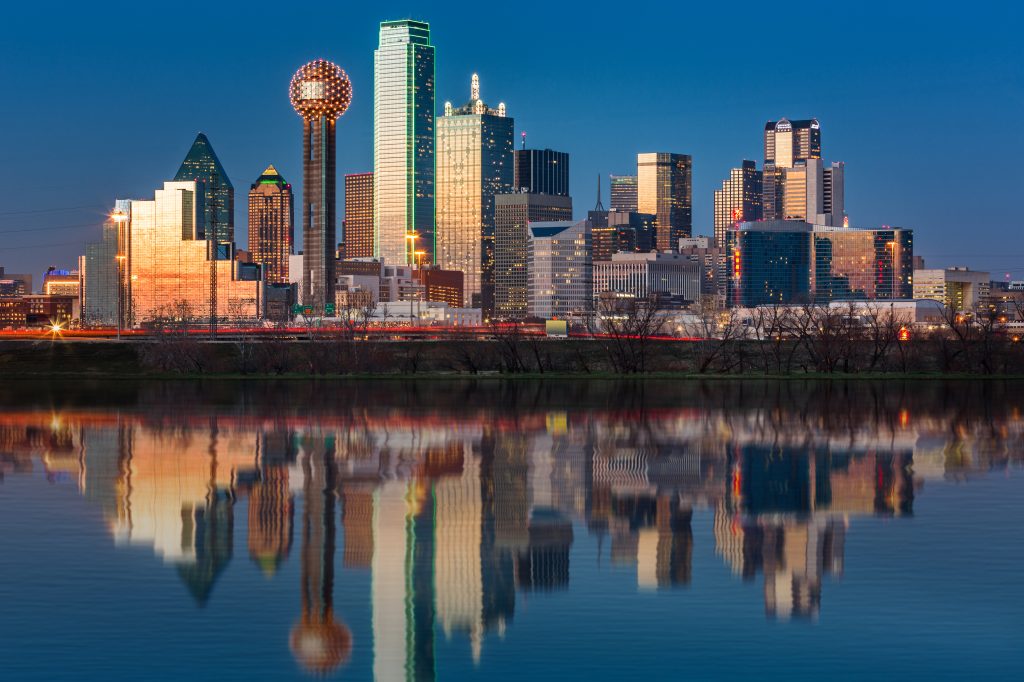
If you’re looking to get a head start on eclipse viewing, Dallas is likely your best bet. The Texas metropolis is not only the largest city in the path of totality but also the first major U.S. destination to experience the event as partial coverage begins at 12:23 p.m. CDT, according to the Perot Museum.
Besides the city’s ample hotel rooms, there are other perks to picking the Lone Star State for catching the eclipse: Experts point out that it’s the place that’s statistically most likely to have clear weather in April when the event occurs, according to travel news outlet The Points Guy.
RELATED: The 10 Best Destinations for Stargazing in the U.S.

Shutterstock / Sean Pavone
If you want to get the most out of your eclipse experience, Indianapolis may be one of your better options. The Indiana capital is near the center of the path of totality, creating a full coverage time of three minutes and 46 seconds, according to the local tourism board. The city will also host NASA at the famous Indianapolis Motor Speedway, providing experts to answer questions and host a live broadcast of the event.

iStock
Lake Placid may have the rare distinction of having hosted the Winter Olympics twice, but 2024 will mark the first time in recorded history the Adirondack locale will experience a total eclipse. The town is planning to welcome visitors with activities and events throughout the Olympic Legacy Sites, providing the opportunity to take in the rare event while surrounded by the region’s famous natural beauty.
RELATED: 12 Best Cities in the U.S. for Outdoor Adventures .

Shutterstock
Those still searching for a spot to catch the eclipse might want to consider Cleveland . The Ohio city is near the center of the path of totality and will experience full coverage for nearly four minutes on Apr. 8, according to the city’s tourism board. Visitors can also look forward to locally hosted events and festivities marking the occasion.

iStock
Arkansas provides another chance to combine natural beauty with the total solar eclipse. Little Rock is just one of the cities in the state with hotel rooms and accommodations to handle the crowds, with the partial eclipse beginning on the earlier side for the U.S. at 12:33 p.m. CDT and finishing at 3:11 p.m., according to NASA.
RELATED: The 10 Most Naturally Beautiful States in the U.S., New Data Shows .

iStock
The U.S. isn’t the only country that will be able to glimpse the eclipse next April: Mexico and Canada will also be on the path of totality. Montreal stands out among these international options for its easy access by flights, ample number of hotel rooms and lodging options, and plenty to see and experience outside of the eclipse itself.
According to the Canadian Space Agency, visitors in the Quebec locale can expect to see full coverage for one minute and 28 seconds, which marks the last time the province will see one until 2106.
RELATED: The 8 Best Off-The-Radar Destinations in the U.S. That Need to Be on Your Bucket List .
iStock
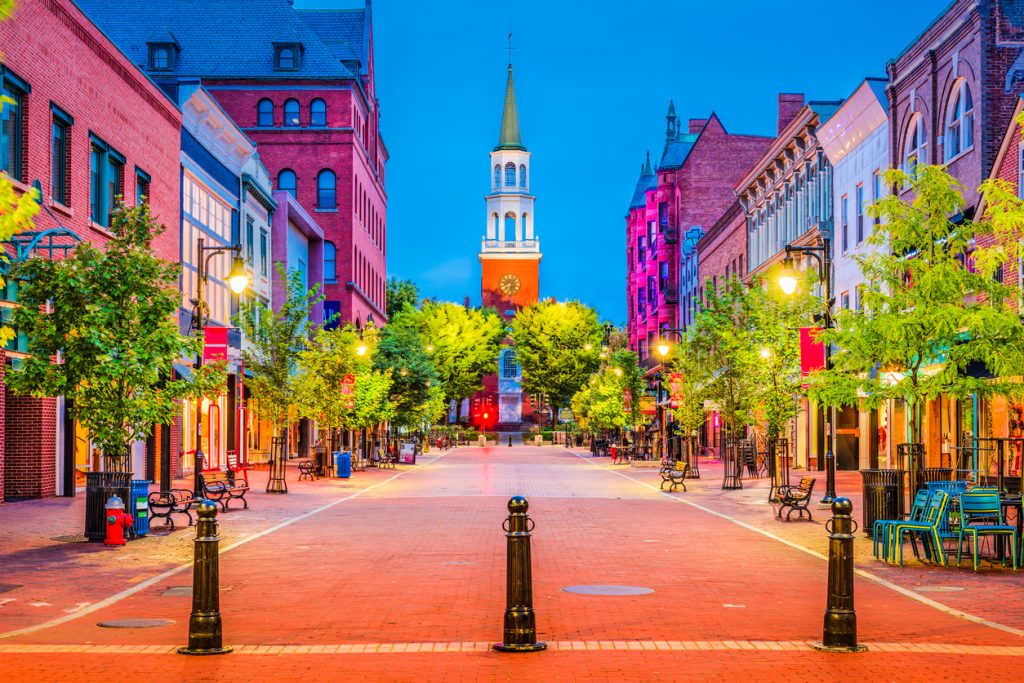
The Green Mountain state provides plenty of reasons to visit year-round, but the 2024 eclipse is a compelling addition to the list. The event marks the first time Vermont has experienced totality since 1932 , according to the state’s tourism board. Those staying in Burlington can expect full sun coverage for about three minutes and will have access to hotels and other lodging in the area.
RELATED: The 7 Newest National Parks You Need to Add to Your Bucket List .
iStock / DenisTangneyJr
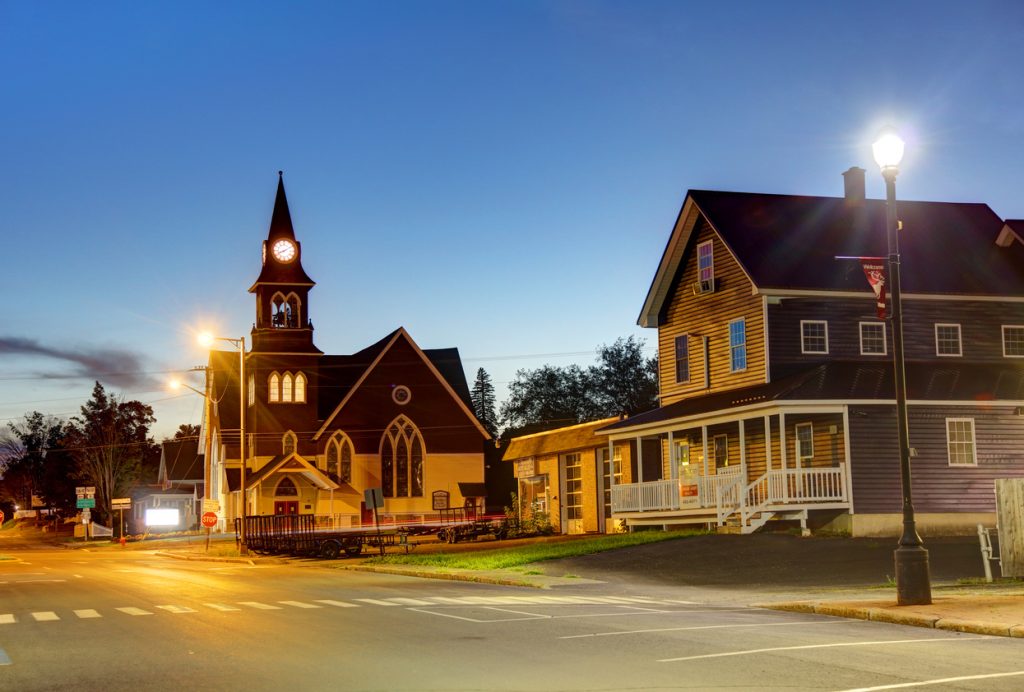
If you’re looking to be among the last in the U.S. to catch sight of the last eclipse until 2044, picking Maine as your viewing locale is the only option. The path of totality crosses the northern half of the state, with full coverage beginning in the small town of Caribou at 3:32 p.m. EDT, according to NASA. After that, the eclipse will pass through the Canadian maritime provinces before ending its traverse of North America and finishing over the Atlantic Ocean.
- Source: https://science.nasa.gov/eclipses/future-eclipses/eclipse-2024/where-when/
- Source: https://www.asc-csa.gc.ca/eng/astronomy/eclipses/total-solar-eclipse.asp
The Next Total Solar Eclipse Will Be the Last Until 2044, NASA Says
Stocker plus/Shutterstock
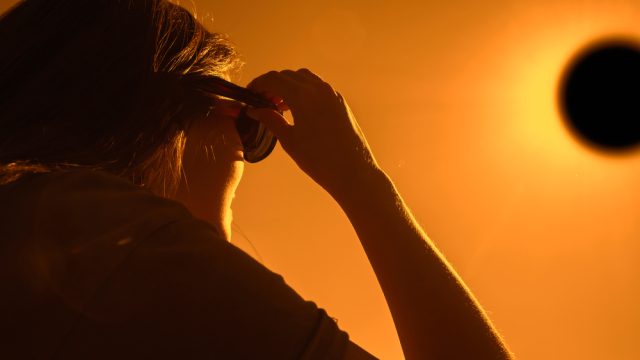
Whether you’re a casual stargazer or a devoted amateur astronomer, there’s no denying that there’s something special about witnessing a rare celestial event like a solar eclipse. Besides the fact that they only occur a few times each decade, getting a good view can come down to where you live having the right weather conditions. If you’d love to witness a solar eclipse anytime soon, you may want to mark off your calendars. NASA says the next one will be the last you can see from the U.S. until 2044. Read on for more info on how to catch this unique event.
READ THIS NEXT: NASA Promises Humans Living on the Moon in 10 Years .
GagliardiPhotography/Shutterstock
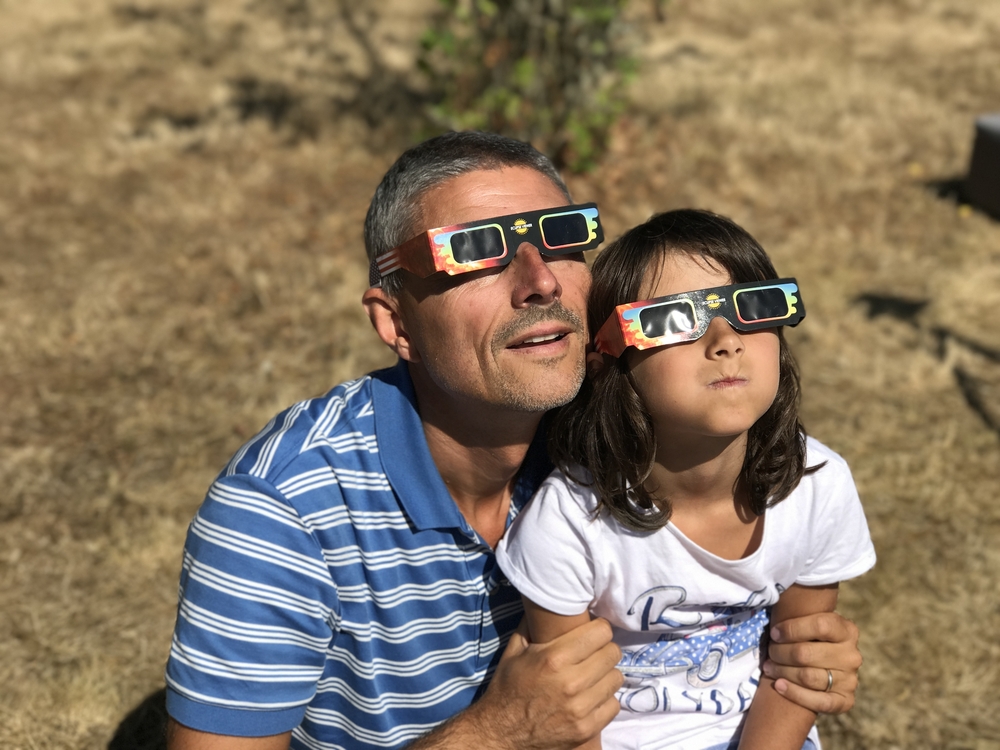
If catching a major cosmic event has been an item on your bucket list, you might want to grab your calendar . On Apr. 8, 2024, North America will have front-row seats to a total solar eclipse for the first time since 2017. But besides being a relatively rare event in and of itself, this will also be the last opportunity to view a full eclipse from within the contiguous United States until Aug. 23, 2044, according to NASA.
Lost_in_the_Midwest/Shutterstock
Even though many areas across the U.S. will be treated to at least a partial eclipse, only places that are in the total eclipse’s direct path will get to experience the moon entirely blocking out the sun . The first sight of totality on the continent will start on Mexico’s Pacific Coast before it becomes visible stateside around noon in Texas, according to NASA. From there, the path will continue north through Oklahoma, Arkansas, Missouri, Illinois, Kentucky, Indiana, Ohio, Pennsylvania, New York, Vermont, New Hampshire, and Maine before leaving the U.S. in the late afternoon.
Viewers in Canada will be able to experience the eclipse as it begins its path through Southern Ontario and eventually makes its way through Quebec, New Brunswick, Prince Edward Island, and Cape Breton. The eclipse will disappear from North America as it passes off the East Coast of Canada in the early evening.
Shutterstock
So long as weather conditions remain favorable, part of what makes the experience of a total solar eclipse so special is the truly unique conditions it can create for those in its path. During the initial partial eclipse phase—or for those watching in areas outside of the total eclipse’s path—viewers will first notice a crescent blocking out part of the sun as the moon slightly covers the star while wearing the appropriate safety glasses, according to NASA.
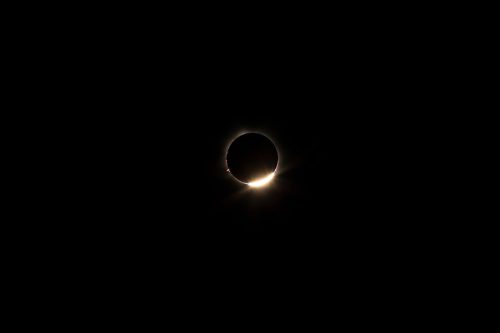
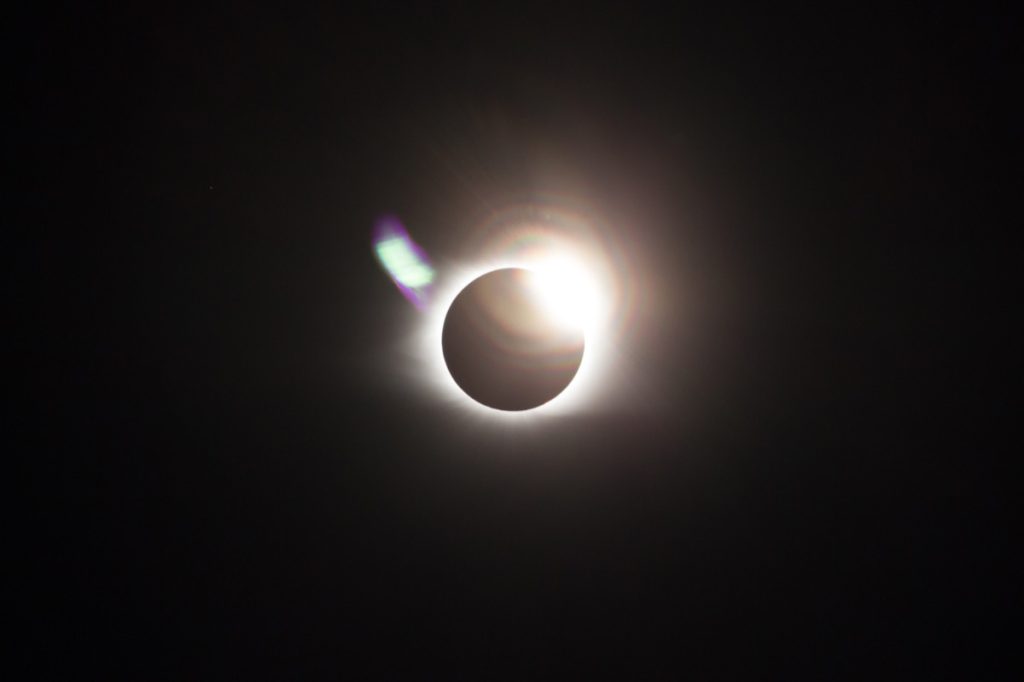
For a few fleeting moments before the sun is covered, spectators might also be able to catch sight of Baily’s Beads, which are glimmers of light that form bright spots as sunlight passes through crags, craters, and valleys on the moon. A sharp, bright spot on the edge of the moon’s shadow known as the “diamond ring” will then appear, named for its resemblance to a sparkling piece of jewelry.
The moment the sun is completely blocked out is known as “totality,” marking the only point of the experience you can watch directly without protective glasses. Spectators might be able to make out different parts of the sun’s atmosphere, including a pink ring created by the star’s chromosphere or rays of white light from the corona. But while the view above is spectacular, sights on the ground can be just as surreal as conditions can create “a 360-degree sunset,” planets and bright stars can become briefly visible, the air temperature can drop, and “often an eerie silence will settle around you,” NASA describes.
Shutterstock / Mihai O Coman
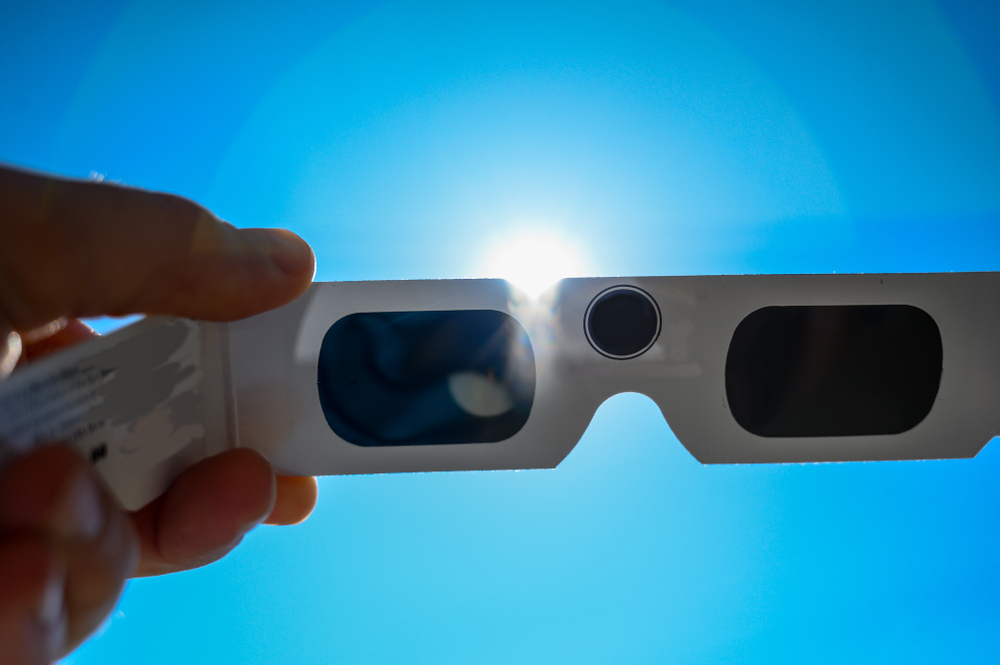
If you’re already excited to catch a glimpse of the rare celestial event for the last time until 2044, it might not be a bad idea to start preparing for the experience. Arguably most importantly, NASA warns you’ll need the correct specially designed safe solar viewing glasses or handheld viewer to actually be able to see it . Otherwise, you’ll need to use an indirect viewing technique, such as a pinhole projector.
“Except during the brief total phase of a total solar eclipse, when the moon completely blocks the sun’s bright face, it is not safe to look directly at the sun without specialized eye protection for solar viewing,” the space agency warns, clarifying that normal sunglasses won’t offer sufficient protection. “Viewing any part of the bright sun through a camera lens, binoculars, or a telescope without a special-purpose solar filter secured over the front of the optics will instantly cause severe eye injury.”
And besides ensuring you have the proper equipment, you might also want to consider arranging a place to stay if you have to travel to witness the event. Cities along the path of totality will likely see a large influx of tourists scooping up available lodging, with Ross saying organizers expect anywhere between 375,000 to 500,000 people to descend upon Rochester alone.
“We’ve been starting to spread the word really since 2019 by meeting and also kind of designating everyone as an eclipse ambassador, so everyone watching right now, get ready because all of your out-of-town relatives are coming here [and] they’re gonna want to stay in your house,” Ross told WROC.
