“Devil Comet” With Horns Is Racing Toward Us—Here’s When and Where It Arrives
iStock
RELATED: 25 Space Mysteries No One Can Explain .
Shutterstock / Ahmed Alqallaf
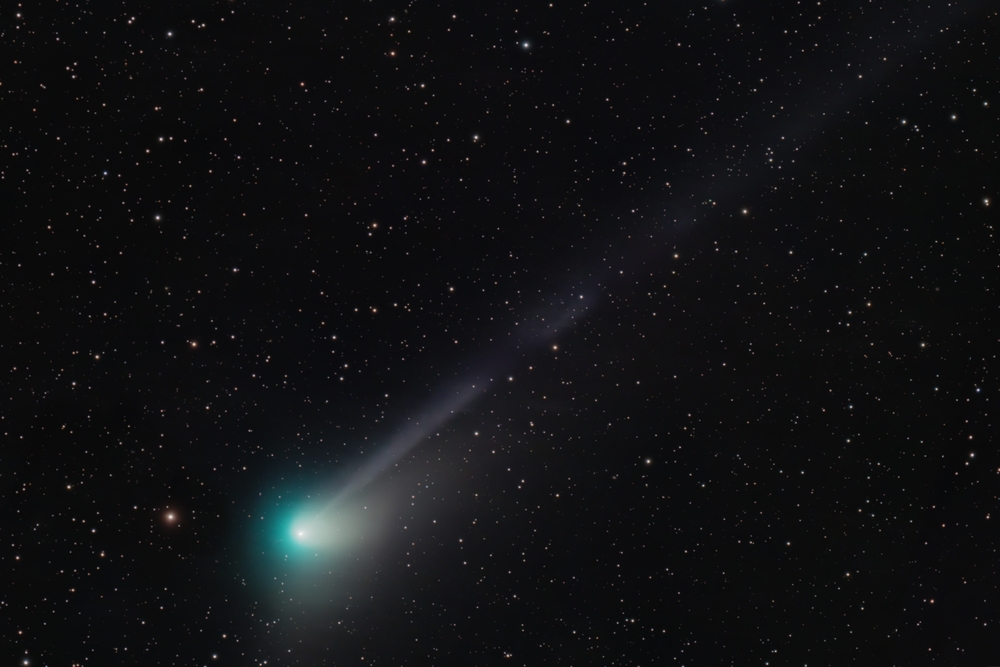
If you thought all comets looked pretty much the same—giant rocks hurdling through the atmosphere with long, steamer-like tails—you’re wrong. Some, like Comet 12P/Pons-Brooks, which has been dubbed a cryovolcanic “devil comet,” have distinct features. In this case, those features are horns.
To brush up on astronomy, comets are large objects that orbit the sun and are made of dust and ice , per NASA. Each comet has a frozen core called the nucleus; as the comet gets closer to the sun and heats up, the ice in the nucleus begins to turn to gas. Bursts of gas can explode from the comet, tearing off poofs of dust. The gas and dust create a cloud around the nucleus called a coma.
It’s the coma that’s responsible for Comet 12P’s horns, and the icy explosions that make it “volcanic.”
RELATED: 8 Amazing Things You Can See in the Night Sky Without a Telescope .
Pol Sole/Shutterstock
Comet 12P has had quite the journey recently. In the past five months, it’s erupted four times—on July 20, Oct. 5, Oct. 31, and Nov. 14—spraying its icy insides into space. After each eruption, the comet’s coma expands, making it appear brighter, and also changes its appearance slightly.
Following the first three eruptions, the comet’s coma developed a hollow space that made it appear to have devil horns. After the eruption in November, the horns disappeared. However, the comet acquired a green hue caused by high levels of dicarbon.
“These outbursts [have] brought this object from being dim enough that you can only really see it with big professional telescopes to, in a couple of cases, something people can see from their backyard,” Theodore Kareta , PhD, a postdoctoral researcher at the Lowell Observatory in Flagstaff, Arizona, told ABC News. “There aren’t that many comets that have outbursts, these sudden increases in brightness, that are so strong, and even fewer that have them a couple of times during one orbit. It seems like Pons-Brooks is just really active.”
RELATED: Scientists Finally Explain Mysterious Signals From Distant “Hell” Planet .

m-gucci/iStock
Comet 12P/Pons Brooks takes 71 years to orbit the sun. It’ll reach its nearest point to the star around April 21, 2024, and its nearest point to the Earth around June 2. The comet might also be seen during next year’s total solar eclipse on April 8, as long as the skies are clear.
Fortunately, there’s no chance of this comet—which is about three times Mount Everest’s size—hitting the planet. Richard Miles of the British Astronomy Association told CBS News it’s about 70 times further from Earth than the moon.
“A collision is entirely out of the question,” he reassured.
Shutterstock
Comet 12P isn’t the only one that should be on your radar. According to Space.com, Comet C/2022 E3 (ZTF) may be visible to the naked eye during the last week of January and early February next year.
Then there’s the annual Geminid meteor shower , one of the year’s best and most reliable, which will take place from Dec. 13 to 14.
Don’t forget to look up!
