Giant Cicada-Killing Wasps Will Descend This Summer—Here’s Where
Shutterstock / samray
The return of summer signals the return of warmer weather and outdoor activities that make the season so enjoyable. However, it also means that certain animals and bugs will also take advantage of the more comfortable conditions. And this summer, giant cicada-killing wasps are expected to descend on parts of the U.S. as they begin hunting. Read on to learn which locations will be affected and other important information about this unique species.
RELATED: Officials Issue New Warning Amid Sudden Surge in Snake Bites—Record Year Predicted .
iStock
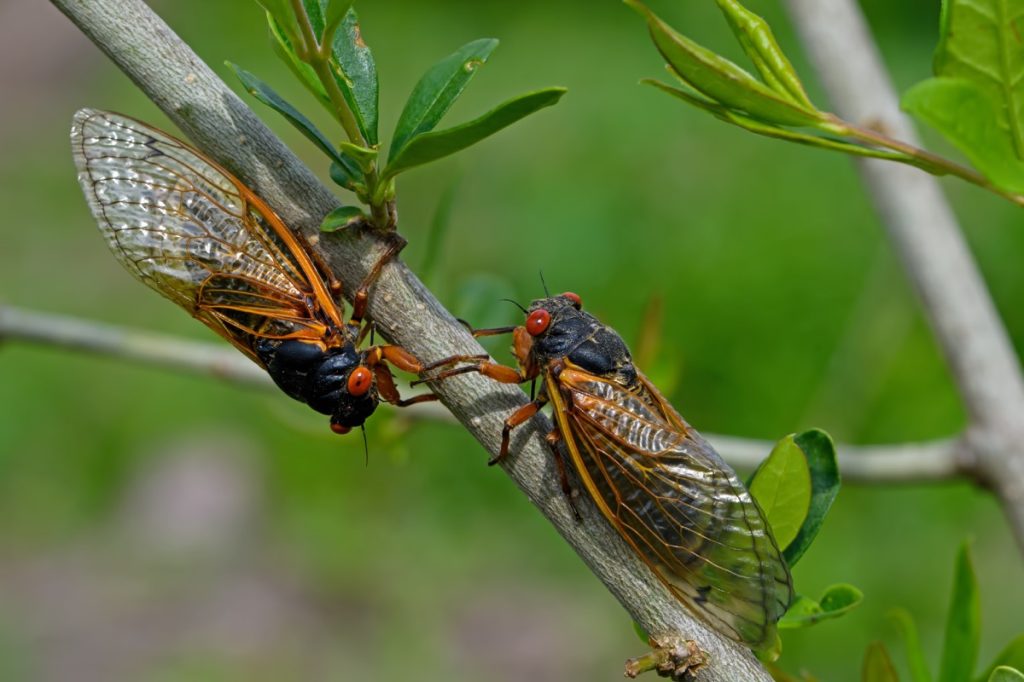
For many, the droning buzz of a cicada is synonymous with warm weather. But this year, some places are expected to get a lot more of the insects than usual as a double brood hatches in what some experts are calling a “cicada apocalypse.”
Beginning next month, Brood XIII will emerge for the first time since 2007 alongside Brood XIX’s first appearance since 2011. Altogether, these two larger swarms will appear in at least 16 states across the Midwest, Southeast, and East Coast, in addition to the annual hatchling, per Cicada Mania.
Experts recently shifted their forecast, now saying that the bugs are expected to show up in late April instead of May or June as previously expected. They’ll likely appear first in southern states , including northern Louisiana, northern Mississippi, northern Alabama, and Georgia, Gene Kritsky , PhD, a professor emeritus of biology at Mount Saint Joseph University, told People .
RELATED: Cicada “Double Brood” Will Descend on These 16 States Next Month .
Shutterstock / Sari ONeal
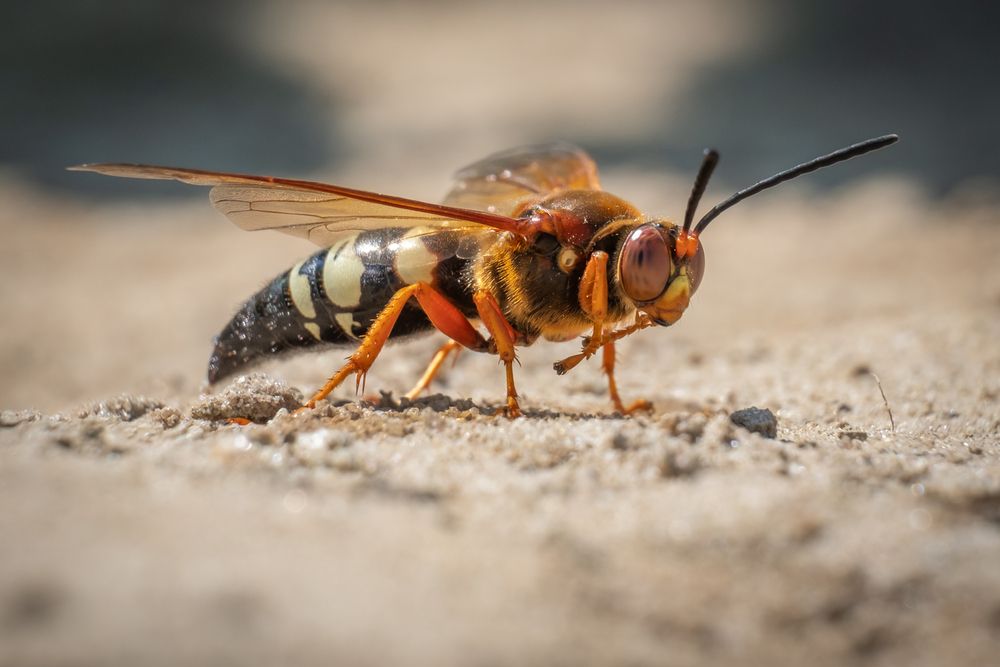
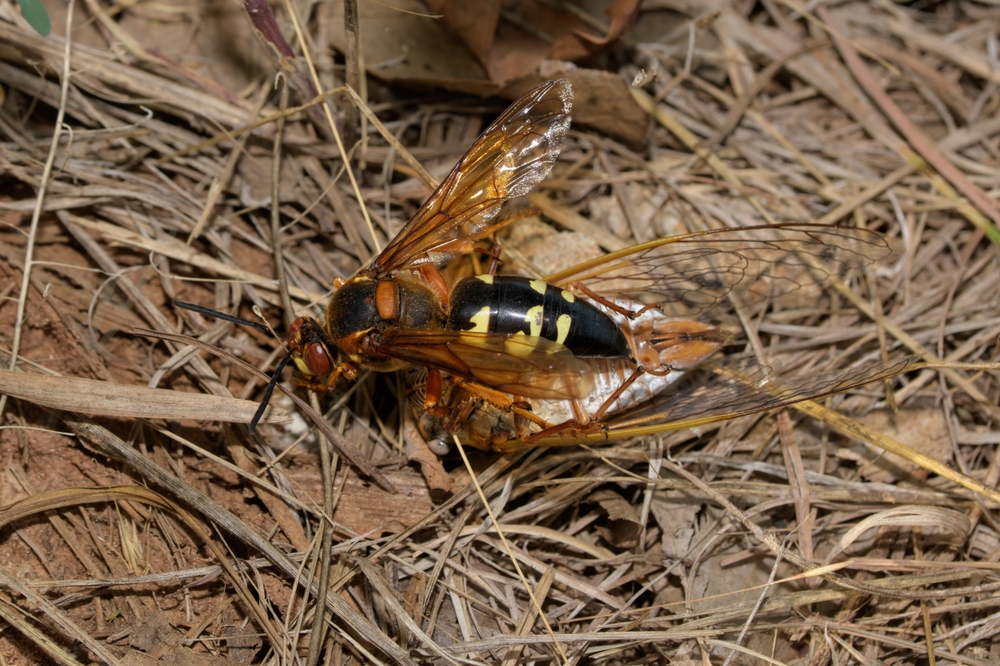
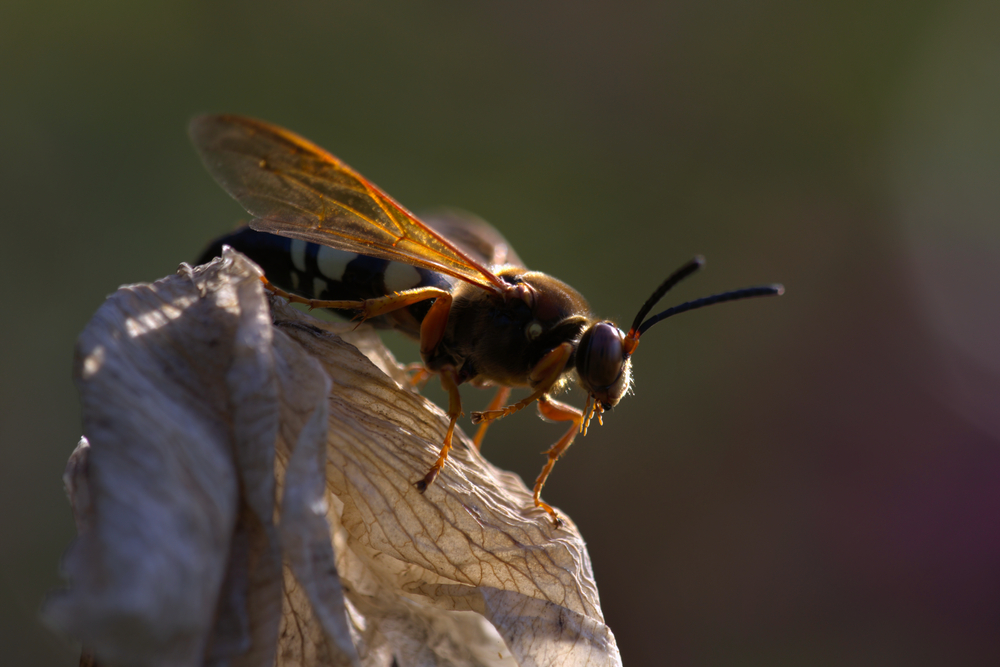
Despite their overwhelming numbers, cicadas still play an essential part in the food chain by attracting predators that feast on the sudden bug buffet. This includes the Eastern Cicada Killer ( Sphecius speciosus ), a giant wasp that lives to do exactly what its name suggests .
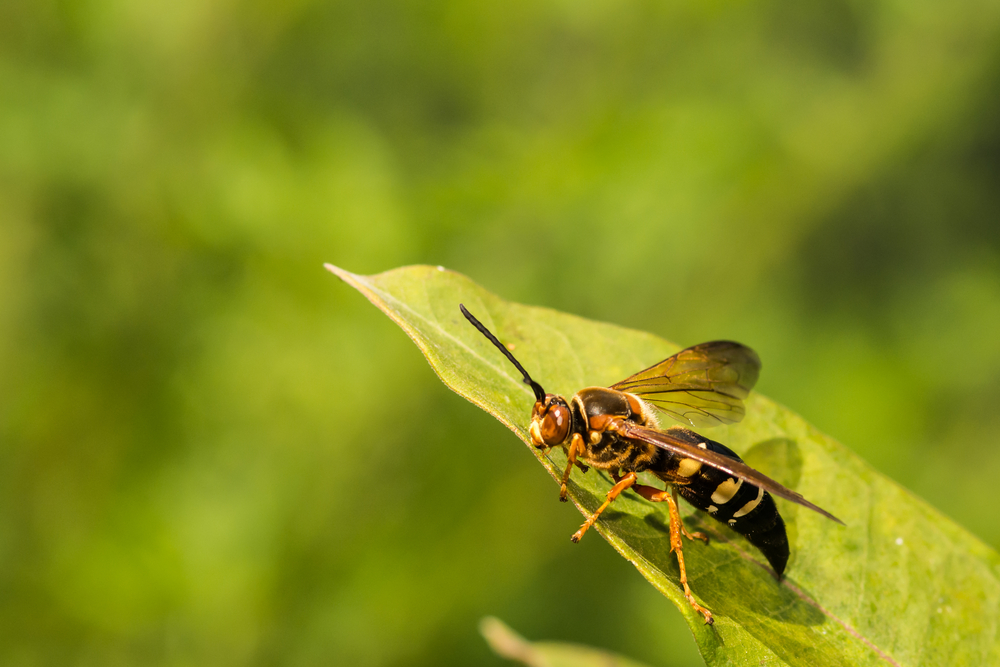
According to the University of Illinois Extension, the flying insects can grow up to 1.5 inches in length and have a black thorax wrapped in three yellow bands. Only females have a stinger, which they use to paralyze cicadas before dragging them back to long burrows that they typically dig beneath trees swarming with their prey. It’s there that the cicadas meet a grim fate.
RELATED: Brand New 21-Foot Snake Discovered: “Biggest of All Anacondas.”
Shutterstock / Jay Ondreicka
Even though the historically large double brood will begin popping up well before summer, it’s unlikely you’ll see any Eastern Cicada Killer wasps that early. They typically hatch each year in late June or July and have a broad habitat that runs everywhere east of the Rocky Mountains in the U.S. wherever cicadas are found, according to the Smithsonian Institution.
But despite being skilled hunters, it’s unlikely that the wasps will help lessen the impact of the double brood.
“By that time, the periodical cicadas have died,” Kritsky told WMAQ. “It is possible a very late periodical cicada could be taken by an early cicada killer wasps, but the two normally coincide together. Therefore the wasps will not have an effect on the periodical cicadas.”
RELATED: 4 Soaps and Scents That Repel Mosquitoes, Experts Say .
Shutterstock / John Reed Pavan
As solitary wasps, Eastern Cicada Killers live in burrows typically dug into embankments near sidewalks, roads, and lawns with loose soil. However, this activity can also become a problem if too many are present, earning the wasps a designation as a “minor pest,” per the Smithsonian Institution.
Despite their sometimes bothersome burrowing, the wasps are still a vital part of the food chain. They’re also described as relatively “mild-mannered,” making the stinger-equipped females less likely to cause a painful run-in, according to the University of Illinois Extension.
“If stepped on or swatted at, they may sting in defense,” Meek told WMAQ.
If you notice the flying insects beginning to burrow in your yard, you can discourage them from getting comfortable by reducing the amount of dry or loose sandy soil, per the University of Illinois Extension. You can also douse these areas with water to drive them off.
Cicada “Double Brood” Will Descend on These 16 States Next Month
AnbachPhotography / iStock
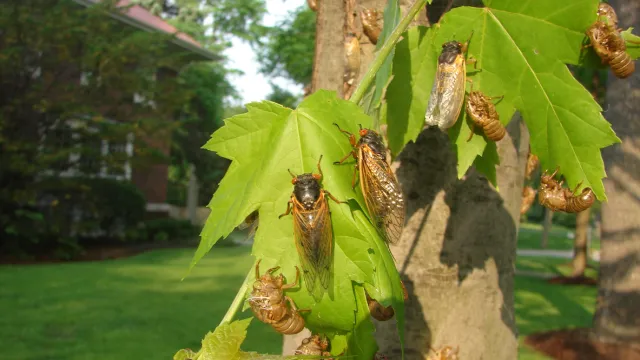
Some will argue that the buzzing sound of cicadas signals the unofficial start of summer—however, this year you may be better off investing in a pair of noise-cancelling headphones. For the first time in 221 years, two different broods of periodical cicadas will simultaneously unleash themselves on one-third of the U.S. in what some are calling a “cicada apocalypse.” And now, experts predict the frenzy could occur as early as next month.
RELATED: Doctors Keep Finding Spiders in People’s Ears—These Are the Tell-Tale Symptoms .
Brood XIII and Brood XIX are the cicada species behind the double emergence, according to ScienceAlert . This year marks Brood XIII’s (“Northern Illinois Brood”) first appearance since 2007, while Brood XIX (“Great Southern Brood”) was last seen 13 years ago.
As alluded in its name, Brood XIII, or the “Northern Illinois Brood,” will make itself known primarily in the Midwest—Iowa, Wisconsin, Illinois, Indiana, and Michigan to be exact, per Cicada Mania . Brood XIX, on the other hand, will cover a lot more ground, emerging in 14 different states: Alabama, Arkansas, Georgia, Illinois, Indiana, Kentucky, Louisiana, Missouri, Mississippi, North Carolina, Oklahoma, South Carolina, Tennessee, and Virginia.
Residents of Illinois and Indiana are in for a very special treat, as they’ll be invaded by both broods.
ScienceAlert previously reported that Brood XIII and Brood XIX would emerge from the soil between May and June 2024. However, biology and wildlife experts are now saying that the cicadas will realistically start popping up at the end of April.
“We’re expecting the periodical cicadas to start emerging in the last week of April at the southern end of their distribution, which is across Northern Louisiana, Northern Mississippi, Northern Alabama, and Georgia,” Gene Kritsky , PhD, a professor emeritus of biology at Mount Saint Joseph University, told People .
As for Brood XIX’s debut, Kritsky said it “could happen as early as the last week of April into the first week of May.”
Regions with cicada overlap will have some time before Brood XIII makes its grand entrance, which isn’t expected to hit until “the last week of May,” Kritsky noted. But even then, that time frame is still earlier than when the brood last emerged in June 2007.
RELATED: Invasive Ladybugs Are Spreading and Excreting “Foul-Smelling” Blood—How to Keep Them Out .
The reason for the difference between Brood XIII and Brood XIX’s emergence has to do with the soil’s temperature. Sixty-four degrees Fahrenheit is the sweet spot, according to Kritsky and wildlife filmmaker Steve Nicholls . Once the soil hits this temperature, the baby cicadas or “nymphs” will shed their exoskeletons and emerge as adults, per ScienceAlert.
But as Kritsky noted, the emergence isn’t a one-day process. “It’s not like all or none; it takes two weeks for all the cicadas to come out in a given location,” he explained to People .
Once above ground, cicadas have about a one-month shelf-life. From start to finish, cicadas will “be present in their emergence areas for about six weeks altogether,” Kritsky explained.
A six-week reign of cicadas may sound terrifying, especially for those in the overlap zone, but Kritsky said it’s more of a fun fact than a warning.
“I think people are expecting to see double the cicadas, a cicada apocalypse or Armageddon,” he said, noting that won’t be the case. “It’s a very narrow area. Moreover, it’s at the extreme edge of both broods. And at the edges of the broods, that’s where the numbers aren’t as great.”
Although a viral tornado of flying loud insects might give you the heebie-jeebies, it would be a once-in-a-lifetime thing to witness. The incredibly rare lineup won’t happen again until 2445.
