Giant Invasive Pythons Are Spreading Fast in Florida and Adapting “Quicker Than Expected”
iStock
RELATED: Giraffe-Sized Python Found in the U.S.—Why They’re Unstoppable .
Shutterstock
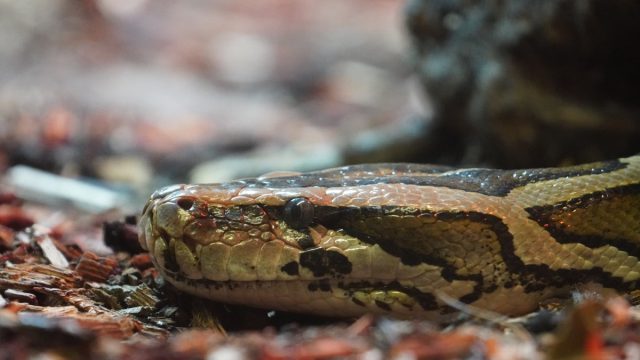
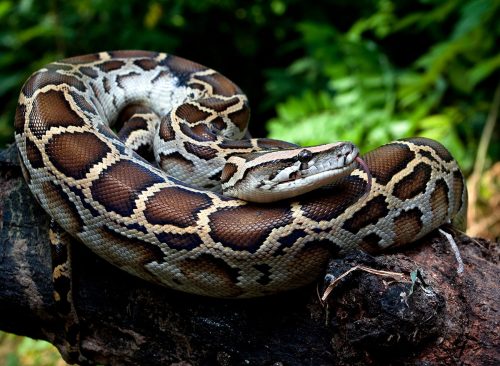
In Feb. 2023, scientists from the U.S. Geological Survey (USGS) released a report about an invasive species of Burmese pythons living in the southern part of Florida. According to the report, it was confirmed that these snakes had established a breeding population in the state’s Everglades National Park in 2000.
“The population has since expanded and now occupies much of southern Florida. They consume a wide range of animals and have altered the food web and ecosystems across the Greater Everglades,” the USGS noted, describing the invasive Burmese python as “one of the most challenging invasive species management issues worldwide.”
RELATED: 209 Giant Invasive Pythons Caught in Florida But Can’t Be Eradicated .
Shutterstock
On the episode, Kristen Hart , PhD, research ecologist with the USGS, told chief meteorologist Tom Sorrells that python DNA has recently been found in Central Florida waterways.
“A colleague of mine has tested certain aquatic areas for the presence of eDNA,” Hart explained. “Imagine being in a bathtub and someone says, ‘Was a human in here?’ You can test it for skin cells. She has done that in places near Kissimmee and things like that to say, ‘Yeah, there’s actual evidence of the Python DNA being in these places.’”
RELATED: 15-Foot Invasive Pythons Are Moving North From Florida and Can’t Be Stopped .
Shutterstock
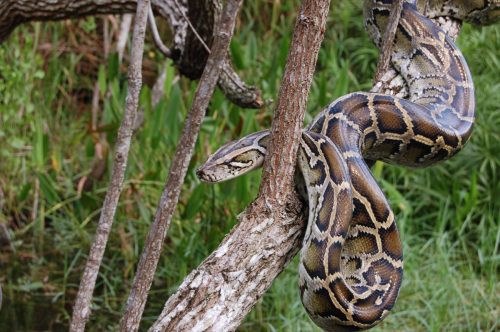
Hart told Sorrells that these Burmese pythons are a formidable predator: They can climb trees, are good swimmers, and can go underground. Worryingly, they are also acclimating to colder temperatures in places like Central Florida “quicker than we expected,” with some snakes even sharing space with gopher tortoises in order to survive cold fronts.
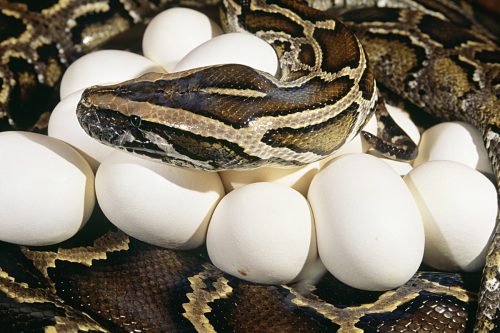
The python population in Central Florida could begin to multiply even faster if male and female pythons end up in the same place together, according to Hart.
“If they can find each other, this is the breeding season. By the time they are [2 years old], they are mature. So they can make babies,” she warned. “This is the sexy season, too, so it really depends what the conditions are around the finding of those individuals. If they were out and about in a wooded area or something—I mean they are looking for mates right now.”
Shutterstock
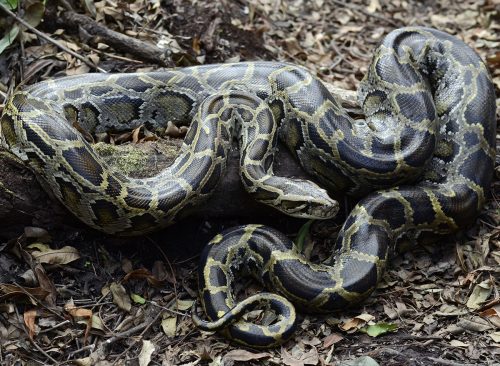
Burmese pythons are apex predators, according to Hart. This means that the closer they move toward humans, the more at-risk dogs, cats, and livestock become. To help, people in Florida are doing their part to conduct annual hunts and capture pythons across the state.
At the same time, Hart said the USGS is considering genetic solutions to sway the population—but there is still a lot of work to do, and it’s seeming more and more unlikely that these snakes can ever be removed completely.
“I don’t know if we are in the eradication game at all, I think we are just in the control plan. They have been here for 40 years. In some places down here [South Florida] they are established,” Hart said.
- Source: Burmese pythons in Florida: A synthesis of biology, impacts, and management tools
