Glowing Green Comet Will Be Closest to Earth Tomorrow—How to See It Before It’s Gone
Shutterstock / AstroStar
Bearing witness to rare events takes on a whole new meaning when it comes to the night sky. While it can be worth watching on any given evening—especially during annual events like meteor showers —the chance to catch a glimpse of something that may not be visible again within our lifetimes is usually enough to motivate people to get outdoors and look up. And if you’re hoping to get in a little more stargazing before the warm summer weather fades, you might want to clear your schedule. That’s because a glowing green comet will be visible when it reaches its closest point to Earth tomorrow. Read on to learn how you can see it for yourself before it’s gone.
RELATED: A Special Solar Eclipse Will Create a “Ring of Fire” in the U.S.—Here’s How to See It .
m-gucci/iStock
Even though it’s our tiny corner of the universe, the vastness of our solar system still makes it surprisingly hard to stay on top of everything that’s happening. And it’s not just learning more about our neighboring planets and the moon with missions to their surfaces: Scientists also only recently discovered Comet Nishimura, which is currently visible in the night sky .
The passing object has become something of a fascination ever since it was first seen by amateur astronomer Hideo Nishimura while taking photos of the night sky on Aug. 10. And while some scientists initially questioned its ability to survive its approach toward the sun, it has lived up to expectations by putting on a show for stargazers worldwide.
“People get pretty excited because naked-eye comets are not so unusual, but not very common,” Quanzhi Ye , a researcher at the University of Maryland who studies comets and asteroids, told The Washington Post . He added that the short timeline from discovery to visibility is “like getting a Christmas present on short notice.”
RELATED: 6 Stargazing Secrets, According to Astronomy Experts .

iStock / mixetto
Our latest passing visitor has also caused a bit of excitement due to how rare its passage by Earth could be. Scientists have estimated that Comet Nishimura likely has a roughly 430- to 440-year orbit , making this fly-by something of a first-time viewing, CNN reports.
That’s because “the last time it passed close to the sun (and might have come closer to Earth) was around the year 1590, before the invention of the telescope,” Paul Chodas , PhD, director of NASA’s Center for Near Earth Object Studies at the Jet Propulsion Laboratory in California, told CNN in an email. “We don’t know whether it got bright enough to be seen with [the] naked eye back then.”
The comet will reach another milestone on Sept. 12 when it reaches its closest point with Earth on its journey toward the center of the solar system. It’s expected to become even brighter along the way, reaching at least roughly the same brilliance as the North Star—and even if it doesn’t stand out like some other close visitors, it will likely still be impressive.
“It’ll be exciting. It’ll be quite bright. But probably not on the level that it’s a comet of the century,” Ye told The Post .
RELATED: The Next Total Solar Eclipse Will Be the Last Until 2044, NASA Says .
m-gucci / iStock
However, you may not want to put off making plans to look for Comet Nishimura. While the object will likely become its brightest when it reaches its closest point to the center of the solar system on Sept. 18, its path will also make it harder to spot.
“Each day this week, the comet is getting a little closer to the sun, the time window gets narrower, and the comet gets even closer to the horizon,” Chodas told CNN. “This will not be an easy comet to see, unless you’ve observed comets before.”
Conditions will also get more challenging as the comet passes Earth, and will likely be more visible from the Southern Hemisphere. “In theory, it might be accessible in the evening sky within a few days after that, but it will still be quite close to the sun in the sky and will be buried in bright twilight,” Alan Hale , co-discoverer of Comet Hale-Bopp and founder and president of the Earthrise Institute, told CNN. “Unless it becomes quite a bit brighter than expected, it will likely not be visible.”
anatoliy_gleb/iStock
The comet’s fleeting viewing opportunity makes it even more important to set yourself up for success while looking for it in the night sky. Your best chances will involve getting up quite early, using the hour and a half leading up to sunrise to stargaze, Vishnu Reddy , PhD, a planetary scientist at the University of Arizona, told The New York Times .
Besides removing yourself from bright city lights, it’s also best to get a clear view of the eastern horizon. Reddy says finding someplace overlooking the ocean, on top of a mountain, or even on a high-rise building can be helpful.
Reddy then suggests looking for Venus just above the horizon once you’ve found a viewing spot. Comet Nishimura will appear to the lower left of the planet as a streak in the sky. The object won’t appear green to the naked eye as it does in photographs, but you can improve your view by bringing along a pair of binoculars. And while it might not be a “giant comet,” Reddy adds that you can take pleasure in knowing it won’t be back in sight on Earth until sometime around the year 2458.
The Next Total Solar Eclipse Will Be the Last Until 2044, NASA Says
Stocker plus/Shutterstock
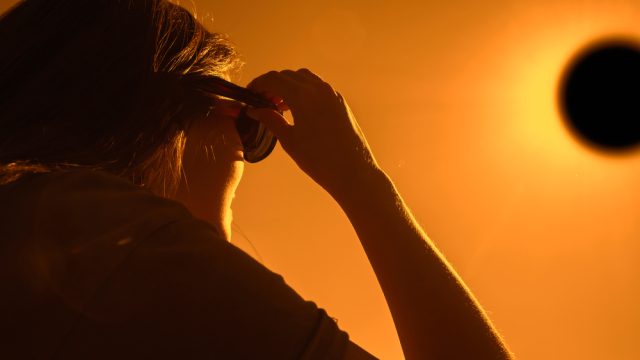
Whether you’re a casual stargazer or a devoted amateur astronomer, there’s no denying that there’s something special about witnessing a rare celestial event like a solar eclipse. Besides the fact that they only occur a few times each decade, getting a good view can come down to where you live having the right weather conditions. If you’d love to witness a solar eclipse anytime soon, you may want to mark off your calendars. NASA says the next one will be the last you can see from the U.S. until 2044. Read on for more info on how to catch this unique event.
READ THIS NEXT: NASA Promises Humans Living on the Moon in 10 Years .
GagliardiPhotography/Shutterstock
If catching a major cosmic event has been an item on your bucket list, you might want to grab your calendar . On Apr. 8, 2024, North America will have front-row seats to a total solar eclipse for the first time since 2017. But besides being a relatively rare event in and of itself, this will also be the last opportunity to view a full eclipse from within the contiguous United States until Aug. 23, 2044, according to NASA.
Lost_in_the_Midwest/Shutterstock
Even though many areas across the U.S. will be treated to at least a partial eclipse, only places that are in the total eclipse’s direct path will get to experience the moon entirely blocking out the sun . The first sight of totality on the continent will start on Mexico’s Pacific Coast before it becomes visible stateside around noon in Texas, according to NASA. From there, the path will continue north through Oklahoma, Arkansas, Missouri, Illinois, Kentucky, Indiana, Ohio, Pennsylvania, New York, Vermont, New Hampshire, and Maine before leaving the U.S. in the late afternoon.
Viewers in Canada will be able to experience the eclipse as it begins its path through Southern Ontario and eventually makes its way through Quebec, New Brunswick, Prince Edward Island, and Cape Breton. The eclipse will disappear from North America as it passes off the East Coast of Canada in the early evening.
Shutterstock
So long as weather conditions remain favorable, part of what makes the experience of a total solar eclipse so special is the truly unique conditions it can create for those in its path. During the initial partial eclipse phase—or for those watching in areas outside of the total eclipse’s path—viewers will first notice a crescent blocking out part of the sun as the moon slightly covers the star while wearing the appropriate safety glasses, according to NASA.
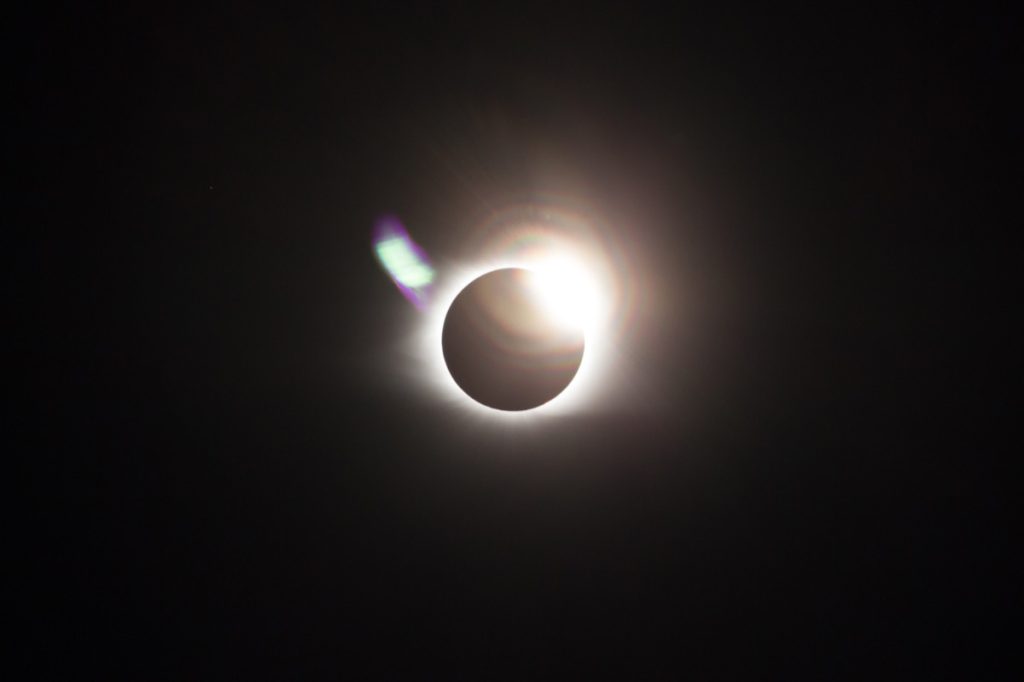
For a few fleeting moments before the sun is covered, spectators might also be able to catch sight of Baily’s Beads, which are glimmers of light that form bright spots as sunlight passes through crags, craters, and valleys on the moon. A sharp, bright spot on the edge of the moon’s shadow known as the “diamond ring” will then appear, named for its resemblance to a sparkling piece of jewelry.
The moment the sun is completely blocked out is known as “totality,” marking the only point of the experience you can watch directly without protective glasses. Spectators might be able to make out different parts of the sun’s atmosphere, including a pink ring created by the star’s chromosphere or rays of white light from the corona. But while the view above is spectacular, sights on the ground can be just as surreal as conditions can create “a 360-degree sunset,” planets and bright stars can become briefly visible, the air temperature can drop, and “often an eerie silence will settle around you,” NASA describes.

Shutterstock / Mihai O Coman
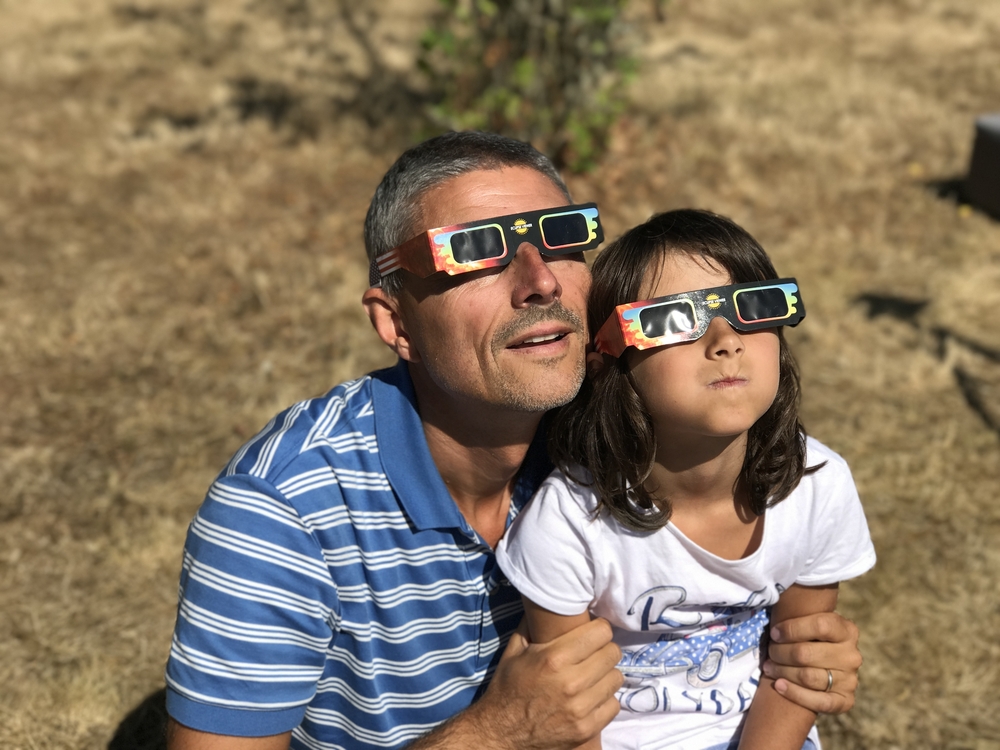
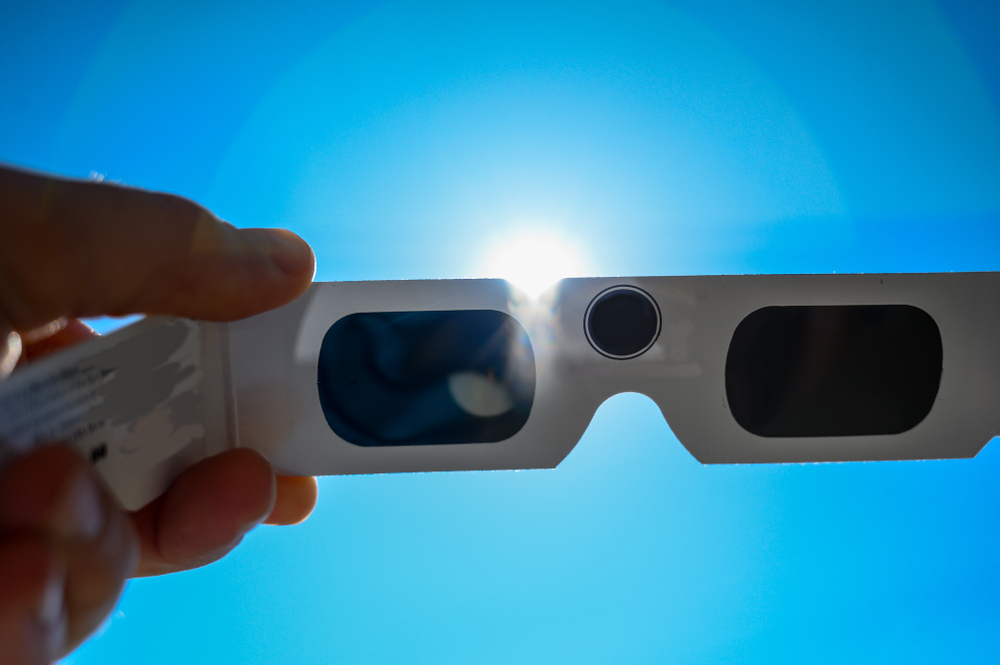
If you’re already excited to catch a glimpse of the rare celestial event for the last time until 2044, it might not be a bad idea to start preparing for the experience. Arguably most importantly, NASA warns you’ll need the correct specially designed safe solar viewing glasses or handheld viewer to actually be able to see it . Otherwise, you’ll need to use an indirect viewing technique, such as a pinhole projector.
“Except during the brief total phase of a total solar eclipse, when the moon completely blocks the sun’s bright face, it is not safe to look directly at the sun without specialized eye protection for solar viewing,” the space agency warns, clarifying that normal sunglasses won’t offer sufficient protection. “Viewing any part of the bright sun through a camera lens, binoculars, or a telescope without a special-purpose solar filter secured over the front of the optics will instantly cause severe eye injury.”
And besides ensuring you have the proper equipment, you might also want to consider arranging a place to stay if you have to travel to witness the event. Cities along the path of totality will likely see a large influx of tourists scooping up available lodging, with Ross saying organizers expect anywhere between 375,000 to 500,000 people to descend upon Rochester alone.
“We’ve been starting to spread the word really since 2019 by meeting and also kind of designating everyone as an eclipse ambassador, so everyone watching right now, get ready because all of your out-of-town relatives are coming here [and] they’re gonna want to stay in your house,” Ross told WROC.
