How to See the Dazzling “Parade of Planets” in the Sky on Monday
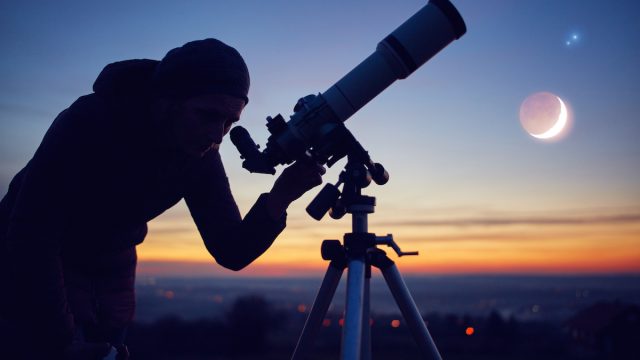
True Touch Lifestyle / Shutterstock
A geomagnetic storm is predicted to make nightfall next week—but before the Northern Lights spectacle , experts are alerting space enthusiasts to another celestial event that’s set to occur during the twilight hours of June 3. Six planets— Jupiter, Mercury, Uranus, Mars, Neptune, and Saturn—will align in a small sector in what some are calling the “ parade of planets .” And Star Walk reports that a phenomenon of this kind won’t happen again until Sept. 2040.
RELATED: New Star Will “Explode” in the Night Sky—How to See the “Once-in-a-Lifetime” Event .
Stargazers first heard about the rare display via a Star Walk social media post. According to the planetarium app, whose Sky Tonight tool can be used to view the parade, a planetary alignment is an “astronomical event when planets gather closely on one side of the Sun at the same time, as seen from above the Solar System.”
“Some people think the Solar System planets can form a straight line as viewed from the Sun. However, the planets cannot achieve full alignment in three dimensions,” explains Star Walk. “Even a looser grouping in one quadrant (a 90-degree sector) is extremely rare: all planets gather in one quadrant only 7 times in the current millennium.”
Around 3:00 a.m. local time on June 3, those north of the equator will get to see the parade of planets up close. As with any celestial encounter, the best viewings occur in areas with little obstruction (like pollution, tall buildings, trees, and city lights). Although onlookers will be able to spot some of the planets without additional help, tools like binoculars are required if you hope to go six for six.
“Mercury, Mars, Jupiter, and Saturn may be spotted with the naked eye, but you’ll need a telescope or high-powered binoculars to see Neptune and Uranus,” says Star Walk.
🌌 Planet Parade on June 3 from Different Cities 🌍 On June 3, 2024, six planets — Mercury, Mars, Jupiter, Saturn, Uranus, and Neptune — will align in the early morning sky. ❗This large planetary alignment sounds exciting but not all the planets will be equally easy to see. 👀… pic.twitter.com/8tqjBDXdTO — Star Walk (@StarWalk) May 29, 2024
If the sky is clear and all goes to plan, some are confident that bystanders will be treated to a dazzling sight. However, broadcast meteorologist Joe Rao isn’t as optimistic. In his Space column, Rao warns that “seeing some of these planets at all will be problematic .”
“People who plan to rise early and step outside on June 3 expecting to see the bloated disk of Jupiter or the rings of Saturn in a single glance will be, at the very least, quite disappointed,” Rao wrote, citing the planetary alignment as a “celestial falsehood.”
According to Rao, the parade will kick off around 2:00 a.m. local time when Saturn begins its ascent in the eastern sky. Without binoculars, the planet will appear as “a relatively bright light glowing with a yellowish-white tint.”
Due to their proximity to the sun, Mercury and Jupiter will also be difficult to spot and will likely be “masked by the brilliant glow of morning twilight,” Roa added. They’ll hang “exceedingly low to the east-northeast horizon” and are predicted to rise 30 minutes before sunrise.
“So, unless you have a nice flat horizon, with no obstructions (like distant buildings or trees) you can probably forget making a sighting of the solar system’s smallest planet (Mercury) next to the largest planet (Jupiter),” said Rao.
Uranus will also be nearly invisible, especially to the unaided eye. “Uranus will rise only about an hour before sunrise, when morning twilight will be well advanced. So, like Mercury and Jupiter, there’s no real chance of seeing Uranus either,” per Rao. If the sky is exceptionally clear and dark, the odds of a sighting increase.
Mars will be a “relatively bright orange light,” falling to the right of the moon, which will take on the shape of a waning crescent, wrote Rao. Conversely, Neptune will be one of the hardest planets to spot, so plan to use binoculars or a telescope.
RELATED: 8 Amazing Things You Can See in the Night Sky Without a Telescope .
While the parade of planets may be less dazzling than expected, fans can still catch bold displays of the moon, Mars, and Saturn. With the right resources like binoculars, a telescope, or a stargazing app, onlookers may also be able to catch a glimpse of some of the harder-to-see planets.
“So, if you step outside at around 3:30 or 4 a.m. on Monday morning, don’t expect to be awed by the sight of a planet parade. What you will likely see is a crescent moon and a bright orange ‘star’ shining to its right (Mars) and farther off to the right will be another relatively bright ‘star’ glowing with a yellowish-white hue (Saturn),” Rao explained.
Northern Lights Could Appear Again Next Week in Short “Window of Opportunity”
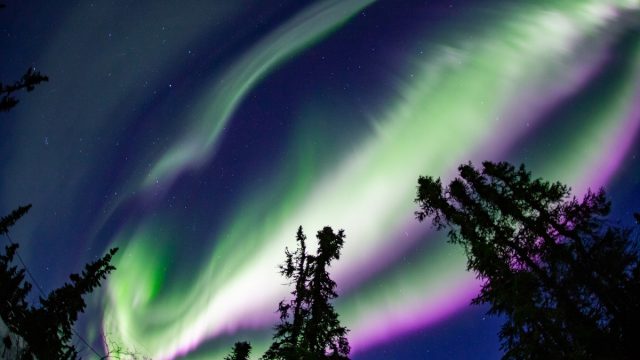
5279210107801613 / iStock
Over Mother’s Day weekend, stargazers had a front-row seat to one of the most spectacular natural light shows to ever grace our country’s night sky. The kaleidoscopic display was viewed in over a dozen U.S. states—an extremely rare occurrence for Americans, as the Northern Lights are typically at their brightest and fullest in the Aurora Zone , which stretches across Iceland, Norway, Sweden, and Canada. But for those who missed it, listen up: Forecasters predict that Aurora Borealis’ second act is just days away.
RELATED: New Star Will “Explode” in the Night Sky—How to See the “Once-in-a-Lifetime” Event .
According to Space , the Northern Lights happen when “energized particles from the sun slam into Earth’s upper atmosphere at speeds of up to 45 million mph.” The fluorescence of these dancing particles can be visible in shades of pink, purple, blue, and green.
“Every type of atom or molecule, whether it’s atomic hydrogen or a molecule like carbon dioxide, absorbs and radiates its own unique set of colors, which is analogous to how every human being has a unique set of fingerprints,” Billy Teets , the director of Dyer Observatory at Vanderbilt University in Nashville, told Space .
The chromatic intensity of the Northern Lights is dependent on the moon’s lunar phrase. As with any celestial light show, a sky without moonlight will provide a bigger (AKA, darker) stage. This makes the event more visible for stargazers on the ground—as was the case with the Mother’s Day spectacle, which occurred right after May’s new moon when the sky was already particularly dark, per Live Science .
However, the May 12 light show was a group effort. According to Live Science , it was “the result of at least five solar storms that hit Earth simultaneously, all originating from a massive sunspot known as active region 3664.” Also known as AR3664/AR13664, the dark patch is estimated to be 15 times wider than Earth.
For many astrophiles, the Northern Lights is truly a once-in-a-lifetime phenomenon. But auspiciously, AR3664/AR13664 will be “Earth-facing” once again when the sun rotates on its axis on June 6. This will also conveniently align with June’s new moon, setting the stage for another glorious light shower.
“It will align nicely,” Ryan French , a solar physicist at Colorado’s National Solar Observatory (NSO), told Live Science . “As soon as the sunspot starts to appear, we will enter the window of opportunity [for viewing auroras].”
Should the auroras make themselves known, it will happen when AR3664/AR13664 reaches the center of the sun. Live Science reports that’s when “the sun-Earth system will be most connected,” and the likelihood of a Northern Lights display is at its peak.
“That’s exactly where it produced all of those large flares,” French explained. “But in theory, if you had a large enough eruption, even if it’s to the left of the sun’s center, we could still get the edge of that impact.”
It takes about 27 days for the moon to complete its orbit around Earth, which means the next new moon will occur around June 6. But scientists suggest checking on the night sky in the days prior because if June’s geomagnetic storm is anything like May’s, we could be in for multiple nights of Northern Lights.
While the Northern Lights are visible to the naked eye, you’ll have a clearer view in regions that aren’t populated with city lights, pollution, and clouds.
