IRS Issues New Alert on What You Must Do Before the Year Is Over

iStock
The stress of tax season is enough to make most of us never want to think about taxes again—let alone in the same calendar year. But you might be hurting yourself down the line if you wait until January to start getting things together for filing. In fact, the Internal Revenue Service (IRS) is now urging taxpayers to make sure they’re completing certain tasks by the end of 2023 in order to avoid potential consequences. Read on to find out what the latest IRS alert entails.
RELATED: IRS Announces Major Tax Filing Changes for Next Year—Are You Affected?
iStock
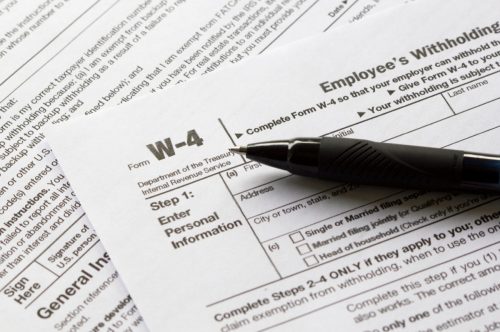
Dom’t wait until the new year to start thinking about your taxes. In a Nov. 3 press release , the IRS issued a new alert about tax withholdings. With 2023 coming to an end, the agency is urging “taxpayers to review their tax withholding as soon as possible.”
“With only a few weeks left in the year, the IRS encouraged people who haven’t checked their withholding recently to do it soon so they can make any withholding adjustments needed,” the agency said in its release.
RELATED: IRS Warns That Claiming These Credits Can Get You Audited and Fined .
iStock
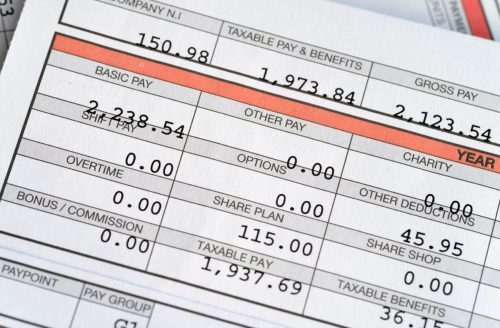
There’s almost always some amount of money coming out of every paycheck, which is our tax withholding . That refers to income tax our employers withhold from our paycheck to pay to the IRS on our behalf throughout the year. But there is no set amount that they’re taking out for everyone across the board—tax withholding varies from person to person.
In fact, the IRS said that about 70 percent of taxpayers withhold too much from their paycheck—which is why they end up with a refund after they file their return. On the other hand, some taxpayers—especially those earning income that’s not subject to withholding, such as income from rental properties, gig economy work, or self-employment—may not be withholding enough during the year, leading to them to have to pay a large balance during tax season.
That’s why the agency is encouraging taxpayers to review their tax withholdings now in order to “avoid a potential surprise” when they submit their return in 2024.
“An adjustment made in the final weeks of 2023 could still help to avoid an unexpected result, such as a big refund or a balance due, when filing taxes next year,” the IRS explained in its release.
RELATED: 6 Tax Return Secrets From Accountants .
iStock
According to the IRS, a person’s regular tax withholding is usually determined by two things: the amount of income you earn, and the information you give your employer on your W-4 form. But the agency said that “common and unforeseen life events can be a trigger to make withholding adjustments.”
For your 2023 taxes, that could include job loss, natural disasters like wildfires or hurricanes, and life changes such as marriage or childbirth.
“The IRS reminds taxpayers that a refund is not guaranteed,” the agency added. “Proper withholding adjustments help people boost take-home pay rather than be over-withheld and get it back as a tax refund.”

iStock
If you want to take the agency’s advice and check your tax withholding, there’s an easy way for you to do so. The IRS has an online tool called the Tax Withholding Estimator that can “help taxpayers determine if they have too much income tax withheld and how to adjust tax withholding,” according to the release.
It can also help you see if you should withhold more or make an estimated tax payment to avoid a large tax bill when you file your 2023 tax return.
“The tool offers workers, retirees, self-employed individuals and other taxpayers a simple-to-use, mobile-friendly way to calculate the correct amount of income tax they should have withheld from wages and pension payments based on their complete set of facts and circumstances,” the IRS stated in its release.
If you use the Tax Withholding Estimator and decide you want to change your tax withholding based on your results, you can do one of three things. You can complete a new W-4 form and submit it to your employer, complete a new W-4P form and submit it to your payer, or make an additional tax payment to the IRS before the end of the year, according to the agency’s website.
Best Life offers the most up-to-date financial information from top experts and the latest news and research, but our content is not meant to be a substitute for professional guidance. When it comes to the money you’re spending, saving, or investing, always consult your financial advisor directly.
- Source: https://www.irs.gov/newsroom/avoid-a-surprise-next-year-review-tax-withholding-now-before-time-runs-out
- Source: https://www.irs.gov/individuals/employees/tax-withholding
- Source: https://www.irs.gov/payments/tax-withholding
IRS Announces Major Tax Filing Changes for Next Year—Are You Affected?
Pgiam/iStock
The fact that we have to pay our taxes every year is one thing that famously never changes. And while there are plenty of different tools to help you file , it’s more often significant changes in your own life that can alter the process. But now, the Internal Revenue Service (IRS) has announced a set of major changes for next year. Read on to see if you’re affected by the latest updates and what it could mean when it comes time to file.
RELATED: IRS Warns That Claiming These Credits Can Get You Audited and Fined .
iStock
Typically, any change in the tax rate is a development that tends to grab plenty of headlines no matter which way it’s heading. But while those numbers will remain the same the next time you file , the IRS has released an updated set of tax brackets for the 2023 tax year.
The adjustments affect where the boundaries are set for each income level, with progressively increasing rates as amounts increase. This year’s changes take into account inflation, with upper limits that are 7 percent higher than brackets in 2022, Forbes reports. And while deductions and other elements must still be factored in, these brackets can help estimate roughly how much you’ll pay when it comes time to file.
RELATED: 4 Warnings About Using TurboTax, According to Experts .

iStock
So, how much will each group now pay? The lowest tax bracket begins at 10 percent for individuals with $11,000 or less in taxable income—or $22,000 for married couples filing jointly. It then ranges from 12 percent for individuals making between $11,001 and $44,725, 22 percent for those with $44,726 to $95,375 in taxable income, and 24 percent for individuals earning between $95,376 to $182,100.
The new rate for individual income between $182,101 and $231,250 is 32 percent, while people earning between $231,251 and $578,125 fall into a 35 percent rate. It tops out with those who take in $578,126 or more in 2023 paying 37 percent. The complete list of updated brackets and rates—including those for married couples filing jointly or separately—can be found on the agency’s website.
RELATED: 5 Reasons the IRS Might Mistakenly Audit You, Finance Experts Say .
RomanR / Shutterstock
But it’s not just your income bracket that could be changing for this year. In a press release on Oct. 17, the IRS also announced that it would begin rolling out its free tax filing program known as Direct File during the 2024 filing season for certain taxpayers.
The service aims to provide an affordable alternative to tax preparation services many people use to file annually. It’s estimated that Americans spend an estimated $11 billion each year nationwide for professional assistance, CBS News reports.
However, not everyone filing will be able to use the service right away. The agency specifies that eligibility will be limited to “taxpayers with relatively simple returns,” targeting those with specific income, credits, and deductions, according to the press release.
RELATED: 6 Tax Return Secrets From Accountants .

Joyseulay / Shutterstock
Besides individual limitations, where you live could also keep you from using Direct File next year. The IRS said the free program will be available to eligible residents in Arizona, California, Massachusetts, and New York, where state governments have worked to incorporate their own taxes into the new system. Those who live in one of the nine states that do not collect state income tax—Alaska, Florida, New Hampshire, Nevada, South Dakota, Tennessee, Texas, Washington, and Wyoming—could also qualify.
Despite its limited initial reach, officials hope the early rollout will reach at least several hundred thousand taxpayers , CNN reports. The initial phase will also help work out any issues and see if the program could be expanded to a broader pool of potential filers.
“The plan is to roll it out in increments that get larger and larger, consistent with how products like this are rolled out in the private sector,” IRS Commissioner Daniel Werfel told reporters during a call, per CBS News. “We want to make sure it is an easy-to-understand pilot.”
