Kroger Promises “Even Lower Prices” for Shoppers—Here’s When
jetcityimage / iStock
Concerns regarding Kroger’s extensive merger with Albertsons —which is expected to be completed during the first half of Kroger’s 2024 fiscal year, according to a CNBC report —continue to leave shoppers divided. However, Kroger wants customers to know that good things are headed their way. In fact, one of the biggest perks that will come from the merger is “even lower prices,” Kroger’s Chairman and CEO Rodney McMullen recently announced.
RELATED: Walmart Shoppers Say Never Buy Great Value “Ever”—Here’s Why .
“We believe the way to be America’s best grocer is to provide great value by consistently lowering prices and offering more choices. When we do this, more customers shop with us and buy more groceries, which allows us to reinvest in even lower prices, a better shopping experience, and higher wages,” McMullen said in a Feb. 13 press release .
McMullen added that he is confident “more fresh, affordable choices” will be a win for both the company and customers as the decision is “consistent with [Kroger’s] approach to previous mergers.”
“This strategy is not new to Kroger. The retailer has invested to lower prices consistently since 2003, resulting in $5 billion in customer savings and providing more affordable products to families across America,” the press release noted.
Be that as it may, many store associates and customers are feeling trepidatious about the pending merger with Albertsons. Fellow industry experts like Michael Needler Jr. , president and CEO of Fresh Encounter, an Ohio-based chain of 98 grocery stores, are worried the merger could have the opposite effect—leading to an increase in prices instead.
“When the large power buyers demand full orders, on time and at the lowest cost, it effectively causes the water-bed effect,” Needler said in an interview with The New York Times . “They push down, and the consumer packaged goods companies have no option but to supply them at their demands, leaving rural stores with higher costs and less availability to products.”
There’s also the fear of store closures , which would consequently result in job losses. In Sept. 2023, the two supermarket chains announced they would be offloading more than 400 stores to C&S Wholesale Grocers, LLC., which operates popular grocery chains like Grand Union and Piggly Wiggly.
RELATED: 6 Secrets Kroger Doesn’t Want You to Know .
If the $24.6 billion deal goes through, Kroger would take ownership of the 24 grocery chains that operate under Albertsons. These include stores such as Vons, Safeway, Jewel-Osco, and Acme. The merger would help Kroger and Albertsons better compete with big-box stores like Walmart, Target, and Costco, per The New York Times .
In the spirit of keeping prices affordable and improving “the customer experience,” Kroger announced on Feb. 13 that it will invest $500 million to lower prices and an additional $1.3 billion to improve Albertsons’ stores following the close of the transaction.
“Kroger expects to grow revenues and drive additional investments in pricing and store improvements as well as wages and benefits,” reads the press release.
Kroger Is Getting Rid of Its Beloved Weekly Ad Insert, Starting Next Month
Kroger
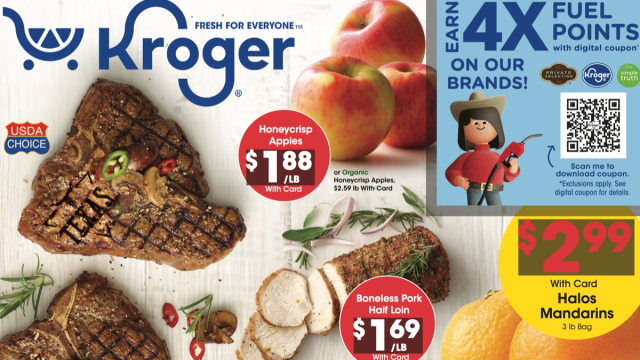
We’re all hunting for the best prices at the grocery store —especially these days. Maybe you’ve swapped out name-brand products for generic ones, or perhaps you’re no longer tossing impulse buys into your cart. But seasoned Kroger shoppers know which items are the best buys before they even get to the store, as deals and sales are spelled out in the store’s familiar weekly ad insert. Customers have relied on receiving these ads at home for years, but this will no longer be the case for many shoppers next month, as Kroger just announced it’s no longer mailing out weekly ads or including them in newspapers in certain markets. Read on to find out more about Kroger’s move to digital only.
READ THIS NEXT: You Can Get Vouchers for Free Items at Kroger—Here’s How .
Shutterstock / Kevin Chen Images
Some of us hold steadfast to print media, maintaining our daily newspaper subscriptions. There’s something comforting about holding the paper in your hand while sipping your morning coffee—and it’s also a convenient way to learn about different sales you don’t want to miss.
Kroger has long sent out its ads in local newspapers or directly to your home, but customers in certain parts of Michigan, Indiana, Mississippi, and Oregon will no longer find these inserts in the mail after May.
Different news outlets report that Kroger is getting rid of paper ads and switching over to digital. Some shoppers in Michigan were informed of the change in the weekly ad for April 19 through 25, which announced, “Your weekly ad is going digital ,” the Detroit Free Press reported.
“Beginning May 28, we’ll no longer deliver printed weekly ads to your home,” the ad sent out in Michigan reads.
Shutterstock
For those who still want the print ad, you can pick up a copy in-store or call Kroger’s hotline at 800-576-4377 to arrange for an ad to be sent to you directly, the Detroit Free Press reported. But in the latest ad, Kroger directs customers to go digital by scanning a quick response (QR) code.
You can access the weekly ad on Kroger’s website or through the app, and once you create an account, you can download “exclusive digital coupons and much more,” the most recent print ad states.
“ Kroger is joining many retailers in shifting the way our weekly ads are distributed,” a company spokesperson told Best Life . “Printed copies will still be available in our stores for customers to peruse. Customers can also view our ads in the Kroger mobile app or at Kroger.com when they are planning their weekly grocery trips.”

Minerva Studio / Shutterstock
The Detroit Free Press noted that some delivery areas in Michigan haven’t received a print ad in quite a while, but customers who just learned of the change aren’t happy about it.
“I like looking through the circular and planning my weekly shopping from it,” Sharon Broshear of Brownstown, Michigan, told the newspaper. “I go through it and mark what’s on sale and decide whether it’s a good price.”
In addition, Kroger shoppers expressed concerns about access for seniors, who may not be comfortable going online or navigating the store’s app. Others said the digital approach could be tricky for people without access to the internet or smartphones.
“While I don’t mind because I can view the ad online, I do think that it would affect those customers who aren’t comfortable accessing the information online (elderly, those without internet, etc.),” Jolyn Felten , administrator and owner of the Bargains to Bounty Facebook page, told the Detroit Free Press . “I know paper ads are available in the store, but it isn’t the same.”
Jonathan Weiss / Shutterstock
In a statement to the Detroit Free Press , Kroger said that it’s discontinuing ad deliveries in some areas while the company “continues to create a simple, convenient grocery shopping experience.” But like many other retailers, Kroger is also going digital to cut costs.
“Kroger has been conducting research for over two years to better understand the changing media consumption habits of our customers, the contribution to sales provided by the printed weekly circular and negative impact to our distribution costs driven by increasing labor and fuel costs,” the company told The Columbus Dispatch about its decision to discontinue print ads.
As Sylvain Perrier , CEO and president of e-commerce solutions company Mercatus, told Grocery Dive, Kroger’s move isn’t all that surprising.
“I think it’s known in the industry, typically, direct cost to producing a flyer normally represents 50 percent of the total marketing budget,” Perrier said in an interview with the outlet. “So that’s printing cost, development and distribution with a very difficult to near impossible way to measure the return on the investment.”
