New Hampshire Just Recorded the Coldest-Ever U.S. Temperature—Could You Survive It?
iStock / cmannphoto
READ THIS NEXT: The Next Total Solar Eclipse Will Be the Last Until 2044, NASA Says .

iStock
Even as an area that is accustomed to freezing winter weather, the Northeast prepared itself for frigid temperatures last week as a major polar vortex hit the region early on the morning of Feb. 3. The approaching extreme conditions led the National Weather Service (NWS) to issue wind chill warnings affecting more than 15 million people, while state officials urged people to stay indoors until the following day, CNN reported.
As temperatures plunged throughout the day and into the following morning, cities in the region reported their own historic lows . Boston, Massachusetts dropped to minus 10 degrees Fahrenheit on the morning of Feb. 4, beating the previous daily record low of minus two and marking the first double-digit negative temperature in the city since 1957, CNN reported. Nearby Worcester also saw double-digit lows as the mercury dropped to minus 13 degrees Fahrenheit, beating the previous daily record of minus four. And Providence, Rhode Island, sunk to a new daily record low of minus nine degrees Fahrenheit.
But while cities throughout New England fell into a deep freeze, temperatures in areas to the north made them look downright balmy.
Mount Washington Observatory
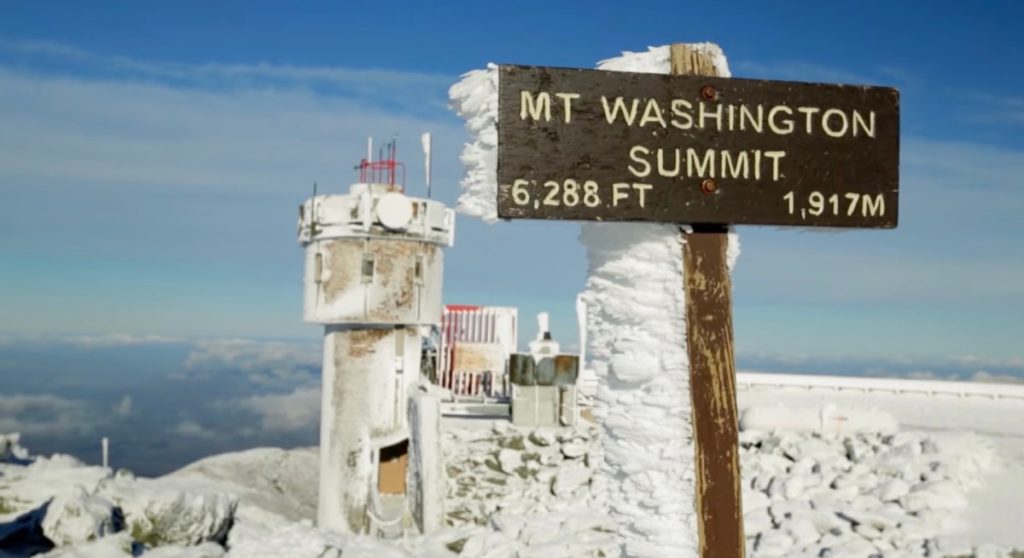
The Mount Washington Observatory in New Hampshire is no stranger to some of the most extreme weather conditions in the nation. And overnight on Feb. 3, scientists crewing the legendary weather station were afforded front-row seats as they braved the elements and recorded what is likely the coldest temperature ever felt in the U.S.
Instruments picked up a new record-low wind chill temperature of minus 108, shattering the previously recorded lowest temperature on the famously frigid summit of minus 102.7 degrees set in 2004, The Washington Post reports. Scientists at the station said that sustained winds at the time were nearly 100 miles per hour, with gusts up to 127 miles per hour.
The NWS also took note of the conditions leading up to the record drop, tweeting on Friday evening: “Right now Mount Washington is living up to the reputation of having the worst weather in the world.” But even those who counted themselves lucky to take part in the historic event admitted it wasn’t exactly a comfortable experience.
“The winds were so strong that I fell over at least once that night. I was thankful that I was able to make it back to the observatory,” Alexis George , meteorologist and weather observer for Mount Washington Observatory, told CNN. “It’s not something you get used to very easily because it’s a very loud experience. It almost sounds like a freight train.”
iStock
Clearly, the extreme conditions recorded at the highest peak in the Northeast are by definition some of the most inhospitable imaginable. But to get an idea of just how bad things were, scientists explained that even their best preparations fell a little short.
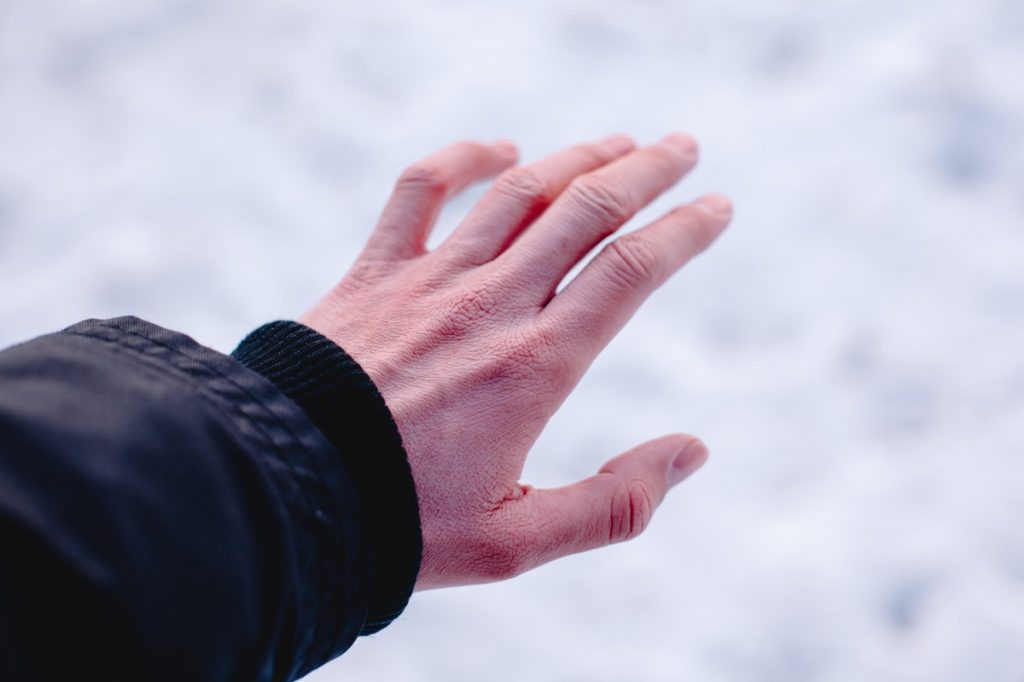
“Any exposed skin, even if it’s just like a millimeter of exposed skin, sort of feels like a bee stinging you or like a low-grade sunburn, so definitely not very pleasant up here,” Francis Tarasiewicz , a weather observer who was part of the three-person team on the record cold night, told CNN.
But temperatures don’t have to drop to record lows for them to become dangerous to your health . According to the NWS, a wind chill of just minus 20 degrees Fahrenheit can cause frostbite in just 30 minutes, which “causes a loss of feeling and a white or pale appearance in extremities, such as fingers, toes, ear lobes or the tip of the nose.” This time also drops drastically as wind speed picks up, shortening to 17 minutes with winds at just five miles per hour.
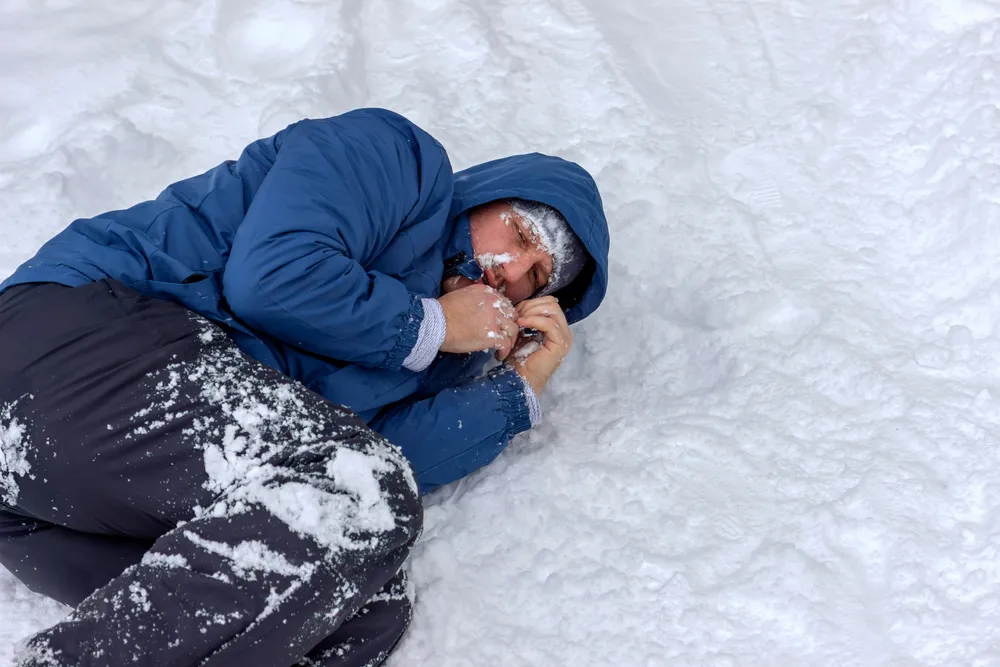
However, a drop in body temperature below 95 degrees Fahrenheit—also known as hypothermia —can be deadly. Anyone who isn’t dressed adequately in temperatures of minus 30 Fahrenheit could begin to experience it in as quickly as 10 minutes, Robert Glatter , MD, an emergency physician at Lenox Hill Hospital in New York City, told Live Science. Temperatures between minus 40 and minus 50 Fahrenheit shorten the window to just five to seven minutes.
Shutterstock / Jelena Stanojkovic
Besides staying indoors and avoiding prolonged exposure to cold temperatures, the best prevention for frostbite and hypothermia comes from adequately dressing for the elements. According to NWS, layers of loose-fitting, lightweight clothing will trap air between fabrics, providing the insulation needed to keep you warmer for longer. It’s also best to choose synthetic fabrics for outer layers over cotton, which can become wet and cool you down very quickly. The agency suggests wearing a hat, covering your mouth to help protect your lungs, wearing mittens instead of gloves, and keeping dry and out of the wind whenever possible.
The NWS also warns that anyone who displays signs or symptoms of frostbite should seek out medical attention immediately. Those suffering from hypothermia are particularly vulnerable and usually show signs of “shivering, memory loss, disorientation, incoherence, slurred speech, drowsiness, and apparent exhaustion.”
Anyone who can’t get medical care in this situation should slowly start warming the body from its core and not the arms and legs as it can lead to heart failure, according to the Centers for Disease Control and Prevention (CDC). The agency suggests using your body heat to help someone suffering and wrapping the head and neck in a warm, dry blanket. It’s also advised not to provide any kind of coffee, hot beverage, food, alcohol, or drugs to someone in this state until they recover.
The Next Total Solar Eclipse Will Be the Last Until 2044, NASA Says
Stocker plus/Shutterstock
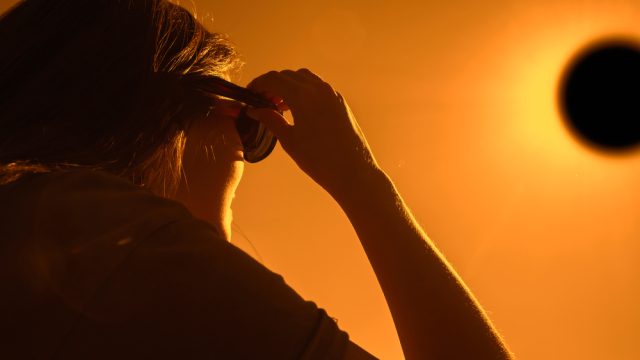
Whether you’re a casual stargazer or a devoted amateur astronomer, there’s no denying that there’s something special about witnessing a rare celestial event like a solar eclipse. Besides the fact that they only occur a few times each decade, getting a good view can come down to where you live having the right weather conditions. If you’d love to witness a solar eclipse anytime soon, you may want to mark off your calendars. NASA says the next one will be the last you can see from the U.S. until 2044. Read on for more info on how to catch this unique event.
READ THIS NEXT: NASA Promises Humans Living on the Moon in 10 Years .
GagliardiPhotography/Shutterstock
If catching a major cosmic event has been an item on your bucket list, you might want to grab your calendar . On Apr. 8, 2024, North America will have front-row seats to a total solar eclipse for the first time since 2017. But besides being a relatively rare event in and of itself, this will also be the last opportunity to view a full eclipse from within the contiguous United States until Aug. 23, 2044, according to NASA.
Lost_in_the_Midwest/Shutterstock
Even though many areas across the U.S. will be treated to at least a partial eclipse, only places that are in the total eclipse’s direct path will get to experience the moon entirely blocking out the sun . The first sight of totality on the continent will start on Mexico’s Pacific Coast before it becomes visible stateside around noon in Texas, according to NASA. From there, the path will continue north through Oklahoma, Arkansas, Missouri, Illinois, Kentucky, Indiana, Ohio, Pennsylvania, New York, Vermont, New Hampshire, and Maine before leaving the U.S. in the late afternoon.
Viewers in Canada will be able to experience the eclipse as it begins its path through Southern Ontario and eventually makes its way through Quebec, New Brunswick, Prince Edward Island, and Cape Breton. The eclipse will disappear from North America as it passes off the East Coast of Canada in the early evening.
Shutterstock
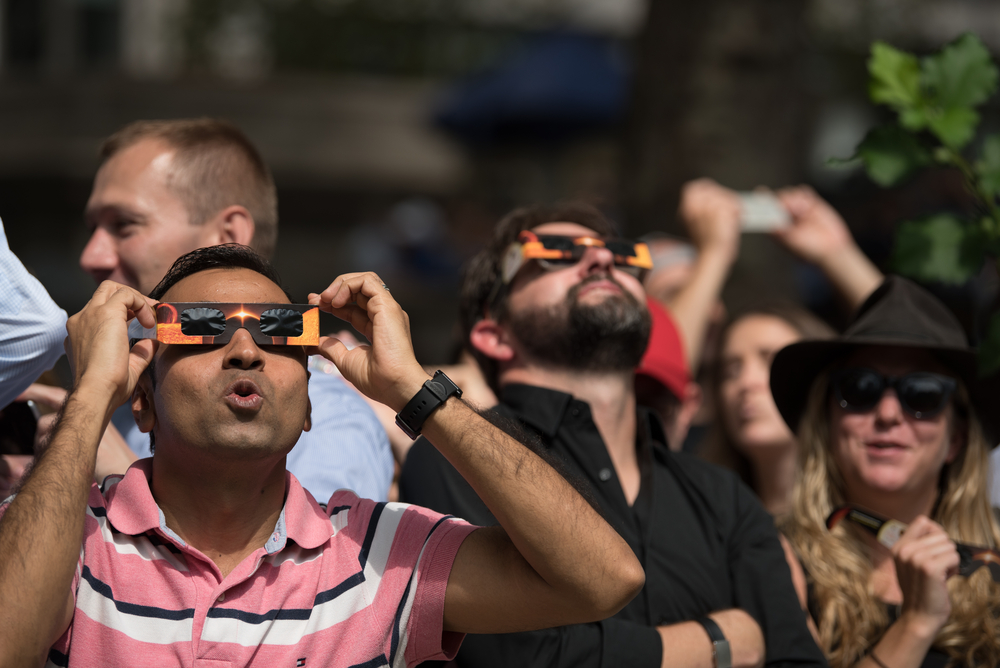
So long as weather conditions remain favorable, part of what makes the experience of a total solar eclipse so special is the truly unique conditions it can create for those in its path. During the initial partial eclipse phase—or for those watching in areas outside of the total eclipse’s path—viewers will first notice a crescent blocking out part of the sun as the moon slightly covers the star while wearing the appropriate safety glasses, according to NASA.
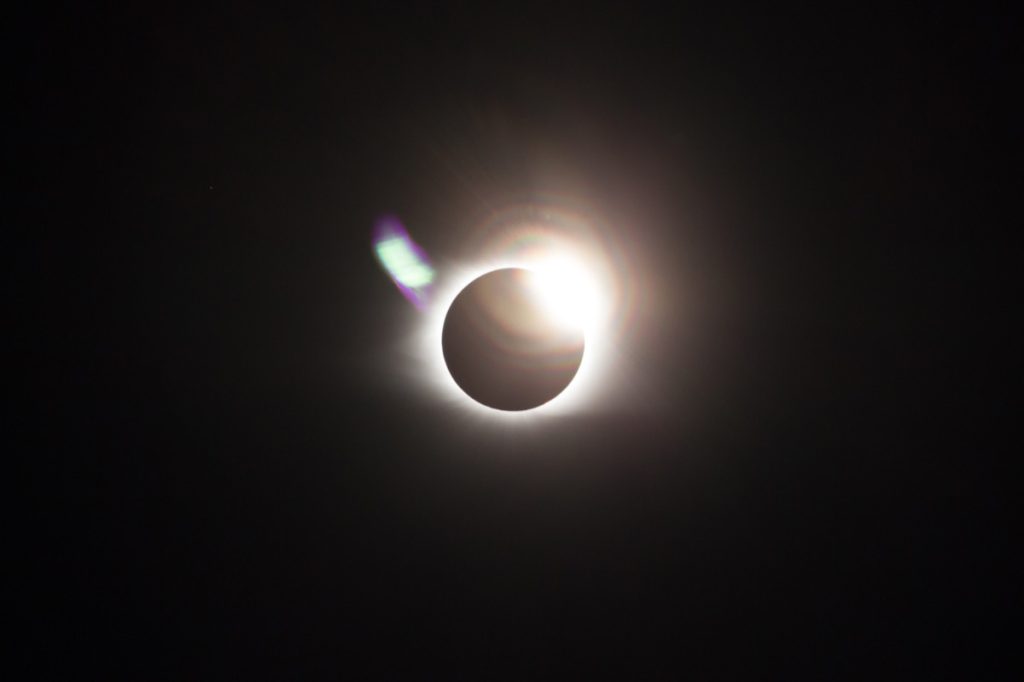
For a few fleeting moments before the sun is covered, spectators might also be able to catch sight of Baily’s Beads, which are glimmers of light that form bright spots as sunlight passes through crags, craters, and valleys on the moon. A sharp, bright spot on the edge of the moon’s shadow known as the “diamond ring” will then appear, named for its resemblance to a sparkling piece of jewelry.
The moment the sun is completely blocked out is known as “totality,” marking the only point of the experience you can watch directly without protective glasses. Spectators might be able to make out different parts of the sun’s atmosphere, including a pink ring created by the star’s chromosphere or rays of white light from the corona. But while the view above is spectacular, sights on the ground can be just as surreal as conditions can create “a 360-degree sunset,” planets and bright stars can become briefly visible, the air temperature can drop, and “often an eerie silence will settle around you,” NASA describes.
Shutterstock / Mihai O Coman
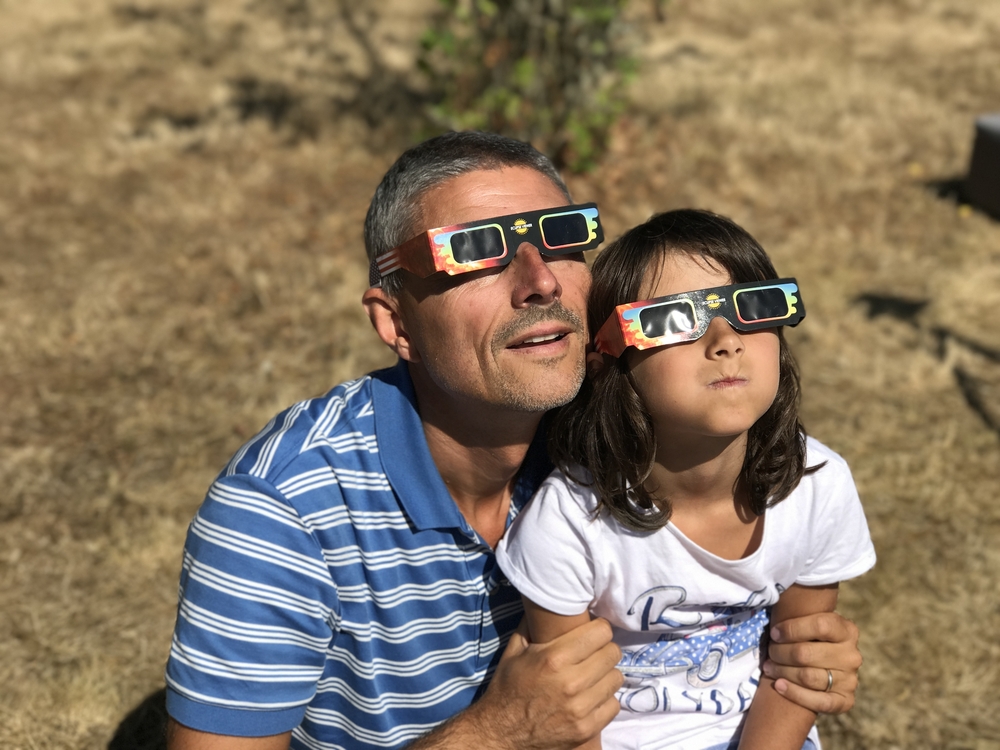
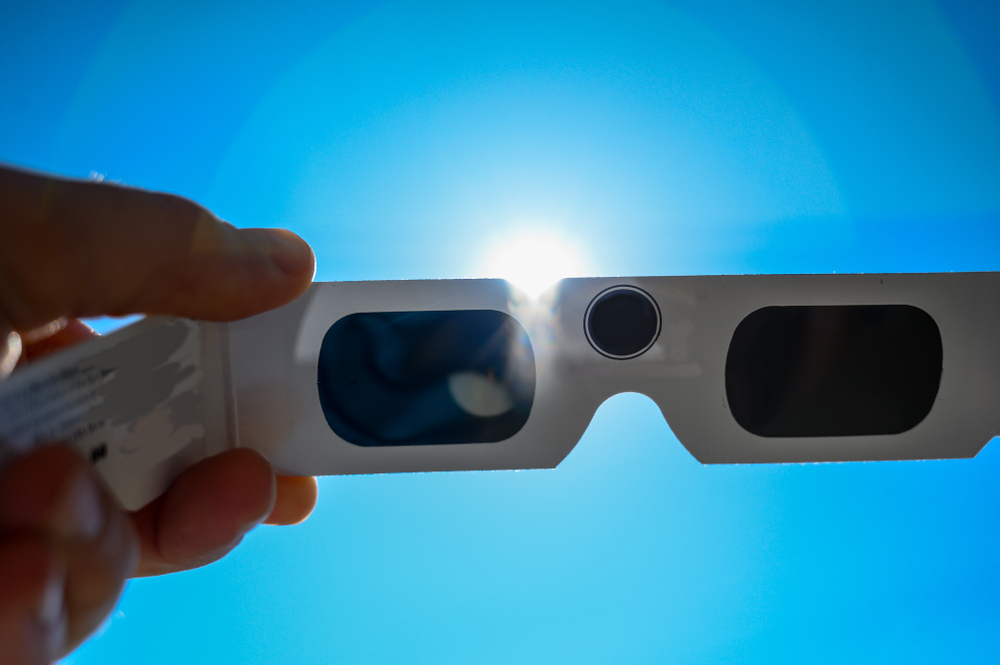
If you’re already excited to catch a glimpse of the rare celestial event for the last time until 2044, it might not be a bad idea to start preparing for the experience. Arguably most importantly, NASA warns you’ll need the correct specially designed safe solar viewing glasses or handheld viewer to actually be able to see it . Otherwise, you’ll need to use an indirect viewing technique, such as a pinhole projector.
“Except during the brief total phase of a total solar eclipse, when the moon completely blocks the sun’s bright face, it is not safe to look directly at the sun without specialized eye protection for solar viewing,” the space agency warns, clarifying that normal sunglasses won’t offer sufficient protection. “Viewing any part of the bright sun through a camera lens, binoculars, or a telescope without a special-purpose solar filter secured over the front of the optics will instantly cause severe eye injury.”
And besides ensuring you have the proper equipment, you might also want to consider arranging a place to stay if you have to travel to witness the event. Cities along the path of totality will likely see a large influx of tourists scooping up available lodging, with Ross saying organizers expect anywhere between 375,000 to 500,000 people to descend upon Rochester alone.
“We’ve been starting to spread the word really since 2019 by meeting and also kind of designating everyone as an eclipse ambassador, so everyone watching right now, get ready because all of your out-of-town relatives are coming here [and] they’re gonna want to stay in your house,” Ross told WROC.
