New Spring Forecast Shows Which U.S. Regions Will Be Warmer and Wetter This Year

iStock
Much of the U.S. has been pummeled with snow and frigid temperatures over the last couple months—but that’ll soon be a distant memory. The National Oceanic and Atmospheric Administration’s (NOAA) Climate Prediction Center (CPC) just released its three-month outlook for March to May, and it looks like some people should expect a dramatic change from the recent winter weather.
According to the CPC, the current El Niño climate pattern is forecast to fade away in the spring. But it’s still expected to impact weather patterns throughout the next few months before we transition to a La Niña pattern in the summer.
“Given the expected rapid transition from El Niño to La Niña, and the increasing global warming trend, it has become difficult to forecast anything but anomalous warmth as we head towards summer,” Todd Crawford , PhD, vice president of meteorology at Atmospheric G2, told The Weather Channel .
But along with above-average temperatures, the CPC is also anticipating above-average precipitation for some parts of the U.S. To find out which U.S regions will be warmer and wetter this spring, read on for a breakdown of the agency’s new spring forecast.
RELATED: “Extended Winter” May Keep Things Cold in These Regions, Meteorologists Predict .
iStock
Most of the West is looking at above-average temperatures from March to May. The states in this region with the highest probability for warmer weather include Washington and Oregon, which have a 60 to 80 percent chance of experience above-normal temps.
But while these parts of the West will likely experience hotter weather this spring, they aren’t expected to find any relief from the rain. Much of the West is expected to experience normal seasonal precipitation, though the CPC predicts that Washington, Oregon, and parts of Idaho and Montana, could see precipitation levels leaning below normal.
RELATED: Meteorologists Warn That “Super El Niño” Could Lead to Intense Hurricane Season .
iStock
Many states in the Midwest are likely to see warmer weather this spring as well. North Dakota, South Dakota, Minnesota, Iowa, Illinois, Wisconsin, Michigan, Indiana, and Ohio, are all forecast to have a 33 to 60 percent chance of experiencing above-average temperatures throughout March, April, and May.
Some of these states might also have a wetter spring, too. The eastern half of Nebraska and Kansas, along with the southern part of Iowa, Illinois, Indiana, and Ohio, and the entire state of Montana have a 33 to 50 percent chance of above-normal precipitation over the next three months.
RELATED: “Significant” Storms Will Bring Rain and 12 Inches of Snow to These Regions .
iStock
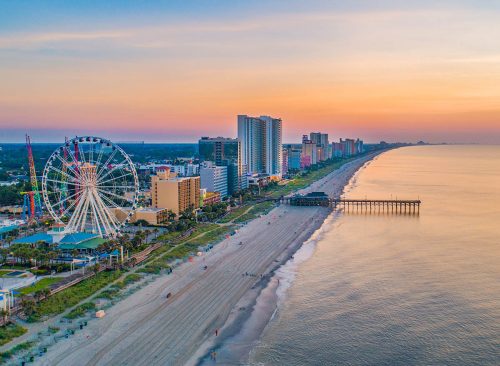
In the South, the biggest worry is more rain in the spring. Every state in this region is predicted to see higher than normal precipitation, but the highest risk is situated right around the lower tip of South Carolina, the bottom half of Georgia, and the northern part of Florida.
Several states are also likely to see warmer conditions as well. There is a 33 to 50 percent chance of above-average temperatures this spring in the upper part of Georgia, as well as South Carolina, North Carolina, Tennessee, Kentucky, West Virginia, Virginia, Maryland, and Delaware.

iStock
Besides Washington state, the highest chance of above-average temperatures this spring is in Northeastern states. Maine, Vermont, New Hampshire, Connecticut, New York, along with the top half of Pennsylvania and New Jersey, have a 50 to 60 percent chance of warmer than normal weather over the next three months.
In this region, an increased chance of rain during that same time is also expected for Pennsylvania, New Jersey, Connecticut, and Rhode Island, as well as the bottom part of New York and Massachusetts.
- Source: CPC: Three-Month Outlook Mar-Apr-May-2024
- Source: CPC: El Niño Discussion
Above-Average Temps Warming Entire U.S. Next Week—How It’ll Affect Your Region

iStock
Most of the U.S. has been huddled under blankets amid frigid temperatures this week. If you’re already sick of all the snow, ice, and arctic air, you may be in luck. A major weather pattern change is expected to reverse trends next week, according to the National Weather Service’s (NWS) Climate Prediction Center (CPC). The CPC just issued its latest temperature outlook , predicting that above-average temps will be warming the entire country through the end of the month. Read on to find out more about how this “transition to a warmer pattern” will affect your region.
RELATED: Winter Storm Bringing Another 8 Inches of Snow to These Regions .

bodnar.photo / Shutterstock
This new warming trend is expected to begin as early as Jan. 21 in parts of the West, CNN reported. By the last week of January, the CPC predicts that most of this region will have a 60 to 80 percent chance of experiencing above-average temperatures.
But that doesn’t mean you’ll be staying dry. The warmer conditions arrive along with storm systems hitting the West next week, which is expected to bring higher rain levels to states like California, according to The Weather Channel. The highest elevations will also see increased snowfall.
RELATED: Why You Should Never Use Your GPS During a Snowstorm, Officials Warn .
Shutterstock
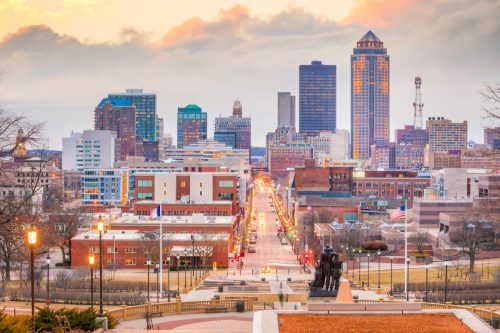
The most dramatic temperature changes are likely to hit midweek throughout the central part of the country, according to CNN. Some areas in the Midwest are expected to shift from temperatures that were 30 to 40 degrees below average last Sunday to temperatures that are 10 to 20 degrees above average by Jan. 24.
Cities such as Des Moines, Iowa, and Minneapolis, Minnesota, are set to see 40- to 50-degree temperature swings‚ making things feel much more like March than like January.
RELATED: Weather Predictions Keep Changing—What the Unpredictable Shifts Mean for You .
Shutterstock
Another blast of cold air is expected to hit the East Coast this weekend. But by early next week, freezing temperatures will have already started to thaw in the South, according to The Weather Channel.
This region is likely to see highs in the 50 and 60s on Monday and Tuesday. Then by mid-week, much of the South will be back in the 60s and 70s.
iStock
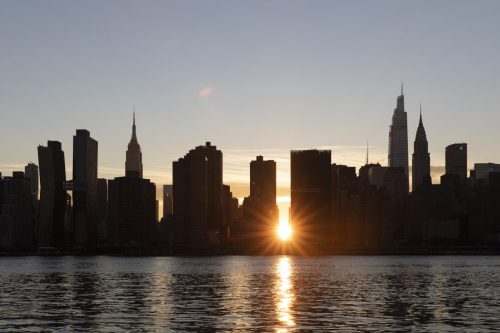
The Northeast is not going to be left out of this warming trend. By the middle of next week, highs in the 40s are expected to be common in places such as Indianapolis, Cleveland, Philadelphia, and New York City, according to CNN.
This will make the region feel like it’s in late February rather than the last weeks of January.
- Source: CPC: 8-14 Day Temperature Outlook
