Parts of the U.S. Will See the Northern Lights in 2024—Here’s Where and When
Shutterstock
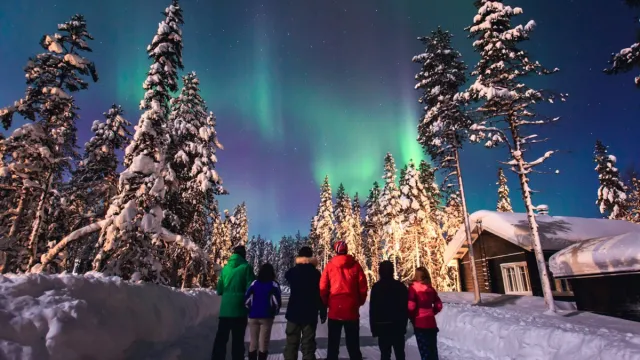
Great news for skygazers : If seeing the Northern Lights sits atop your bucket list, 2024 could very well be a year to remember. Scientists say that thanks to increased solar activity, the stunning light display usually seen only from countries within the Arctic Circle will be viewable from right here in the United States. However, you won’t be able to see the aurora borealis from everywhere—only a few select locations will be lucky enough to serve as a backdrop for this striking solar show. Here’s when and where to see the Northern Lights in the U.S.A. in 2024.
RELATED: 8 Best Destinations for the Next (and Rare) Total Solar Eclipse .
What are the Northern Lights?
To get the full Northern Lights experience, it can help to understand the scientific explanation for what you’re seeing when the sky turns that ethereal shade of green and the light seems to dance.
According to NOAA’s Space Weather Prediction Center (SWPC), auroras occur “when electrons from space flow down Earth’s magnetic field and collide with atoms and molecules of the upper atmosphere in a ring or oval centered on the magnetic pole of Earth. The collisions produce light much like how electrons flowing through gas in a neon light collide with neon and other gasses to produce different colored light bulbs.”
When there are more geomagnetic storms—resulting in more solar wind streaming from the sun and heading for collision—the Northern Lights occur more frequently and with greater visual intensity.
The Northern Lights then appear in the “auroral oval”—an area that can shrink or grow depending on solar activity. “As the solar wind increases in speed and the interplanetary magnetic field embedded in the solar wind turns southward, the geomagnetic activity will increase and the aurora will become brighter, more active, and move further from the poles,” explains the SWPC.
RELATED: 25 Space Mysteries No One Can Explain .
Where to see the Northern Lights in the U.S.A.
In 2024, the sun will reach “ solar maximum ,” the peak of an 11-year cycle in which the North and South poles switch places. When this happens, solar activity will be at its highest point and the auroral oval will expand.
“When there’s more energy, [the auroral zone] gets thicker and expands further south ,” Don Hampton , research associate professor at the Geophysical Institute of the University of Alaska Fairbanks, recently told National Geographic . “I don’t think it is too wild a prediction to say that people in the midwest and maybe even lower midwest (40th parallel) will have a good chance to see aurora once or twice during this solar cycle, but there are no guarantees.”
The publication notes that in the U.S., the 40th parallel runs through Provo, Utah; Boulder, Colorado; north Indianapolis; and Columbus, Ohio.
And as Best Life previously shared , the northernmost parts of Michigan and much of Alaska may also get the chance to view the spectacle.
It can be hard to predict long in advance when will be the best time to see the Northern Lights. That’s why National Geographic recommends downloading aurora-forecasting apps such as Aurora Alerts and My Aurora Forecast & Alerts for the most up-to-date information in your area. However, generally speaking, the Northern Lights are most often viewable around the March and October equinoxes, Magnus Wik , a space weather scientist at the Swedish Institute of Space Physics , tells the outlet.
8 Best Destinations for the Next (and Rare) Total Solar Eclipse

LeoPatrizi/iStock
The chance to witness a total solar eclipse is rare enough that it remains a bucket list item for many people. After all, these events require a combination of being in the right place at the right time and having the correct conditions to actually see them. Since the next eclipse will be the last visible from North America until 2044 , many are making plans well ahead of the event on Apr. 8, 2024, to secure front-row seats.
The hype has created a mad dash for accommodations in locations along the path of totality , which will start in Texas and run across 13 states through Maine, according to NASA. In some places, basic hotel rooms are going for five to seven times their typical rates—including some listed well above $1,000 for a night, The New York Times reports.
The pinch is even being felt in the short-term home rental market, with some avid eclipse chasers saying supply has been dwindling even months in advance. Others reported finding decent rates, only to have hosts cancel their reservations and demand a higher price point for the occasion, The Times reports.
Some experts have recommended finding lodging within an hour’s drive of the path of totality to avoid a price crunch. But others still warn that the expected crowds will likely bring traffic jams along with them on the big day.
“It’s a little bit like going to a big sporting event where people take their time getting in but everybody wants to leave at the same time,” Scott Katsinas , a travel adviser at Katsinas Travel Consultants in Arizona, told The Times .
But even as accommodations run thin in some places, there’s still hope for those who want to experience the event for themselves. Local tourism boards have collected resources for eclipse chasers with options along the path of totality for the big day. Read on for the best destinations for watching the next total solar eclipse in 2024.
RELATED: Southwest Says You Can View the Total Solar Eclipse on These 8 Flights .
Shutterstock / Mihai_Andritoiu
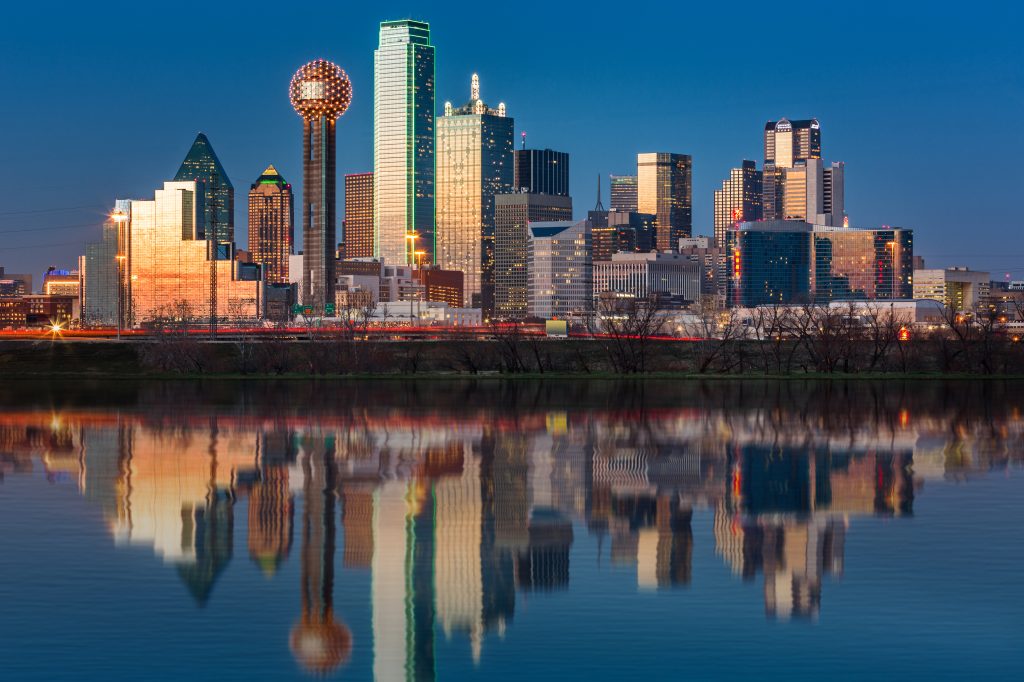
If you’re looking to get a head start on eclipse viewing, Dallas is likely your best bet. The Texas metropolis is not only the largest city in the path of totality but also the first major U.S. destination to experience the event as partial coverage begins at 12:23 p.m. CDT, according to the Perot Museum.
Besides the city’s ample hotel rooms, there are other perks to picking the Lone Star State for catching the eclipse: Experts point out that it’s the place that’s statistically most likely to have clear weather in April when the event occurs, according to travel news outlet The Points Guy.
RELATED: The 10 Best Destinations for Stargazing in the U.S.

Shutterstock / Sean Pavone
If you want to get the most out of your eclipse experience, Indianapolis may be one of your better options. The Indiana capital is near the center of the path of totality, creating a full coverage time of three minutes and 46 seconds, according to the local tourism board. The city will also host NASA at the famous Indianapolis Motor Speedway, providing experts to answer questions and host a live broadcast of the event.

iStock
Lake Placid may have the rare distinction of having hosted the Winter Olympics twice, but 2024 will mark the first time in recorded history the Adirondack locale will experience a total eclipse. The town is planning to welcome visitors with activities and events throughout the Olympic Legacy Sites, providing the opportunity to take in the rare event while surrounded by the region’s famous natural beauty.
RELATED: 12 Best Cities in the U.S. for Outdoor Adventures .

Shutterstock
Those still searching for a spot to catch the eclipse might want to consider Cleveland . The Ohio city is near the center of the path of totality and will experience full coverage for nearly four minutes on Apr. 8, according to the city’s tourism board. Visitors can also look forward to locally hosted events and festivities marking the occasion.

iStock
Arkansas provides another chance to combine natural beauty with the total solar eclipse. Little Rock is just one of the cities in the state with hotel rooms and accommodations to handle the crowds, with the partial eclipse beginning on the earlier side for the U.S. at 12:33 p.m. CDT and finishing at 3:11 p.m., according to NASA.
RELATED: The 10 Most Naturally Beautiful States in the U.S., New Data Shows .

iStock
The U.S. isn’t the only country that will be able to glimpse the eclipse next April: Mexico and Canada will also be on the path of totality. Montreal stands out among these international options for its easy access by flights, ample number of hotel rooms and lodging options, and plenty to see and experience outside of the eclipse itself.
According to the Canadian Space Agency, visitors in the Quebec locale can expect to see full coverage for one minute and 28 seconds, which marks the last time the province will see one until 2106.
RELATED: The 8 Best Off-The-Radar Destinations in the U.S. That Need to Be on Your Bucket List .
iStock
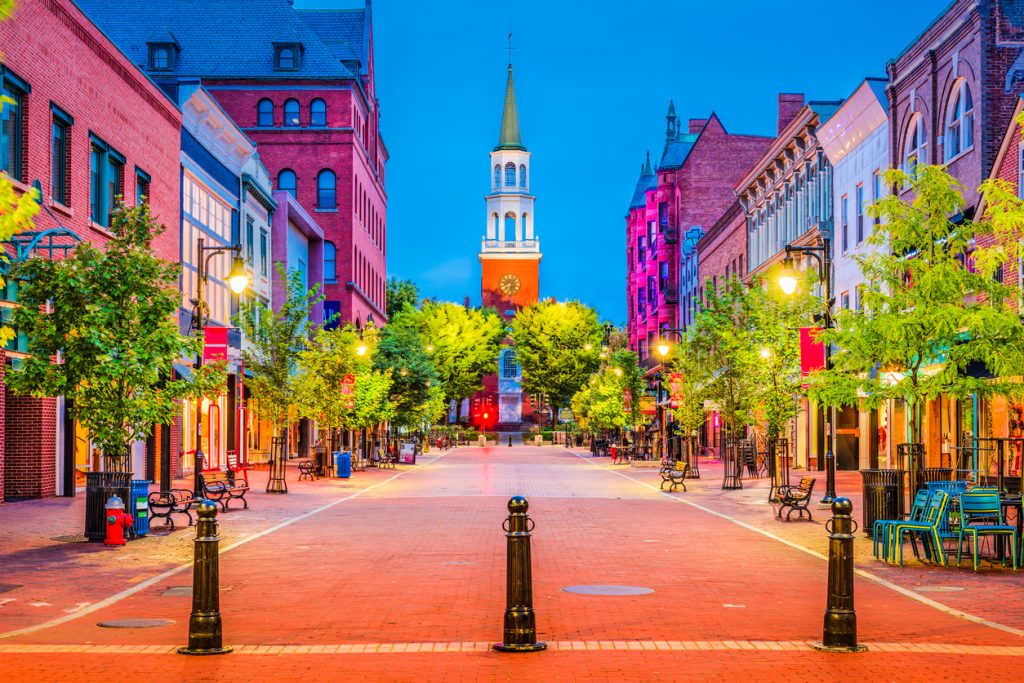
The Green Mountain state provides plenty of reasons to visit year-round, but the 2024 eclipse is a compelling addition to the list. The event marks the first time Vermont has experienced totality since 1932 , according to the state’s tourism board. Those staying in Burlington can expect full sun coverage for about three minutes and will have access to hotels and other lodging in the area.
RELATED: The 7 Newest National Parks You Need to Add to Your Bucket List .
iStock / DenisTangneyJr
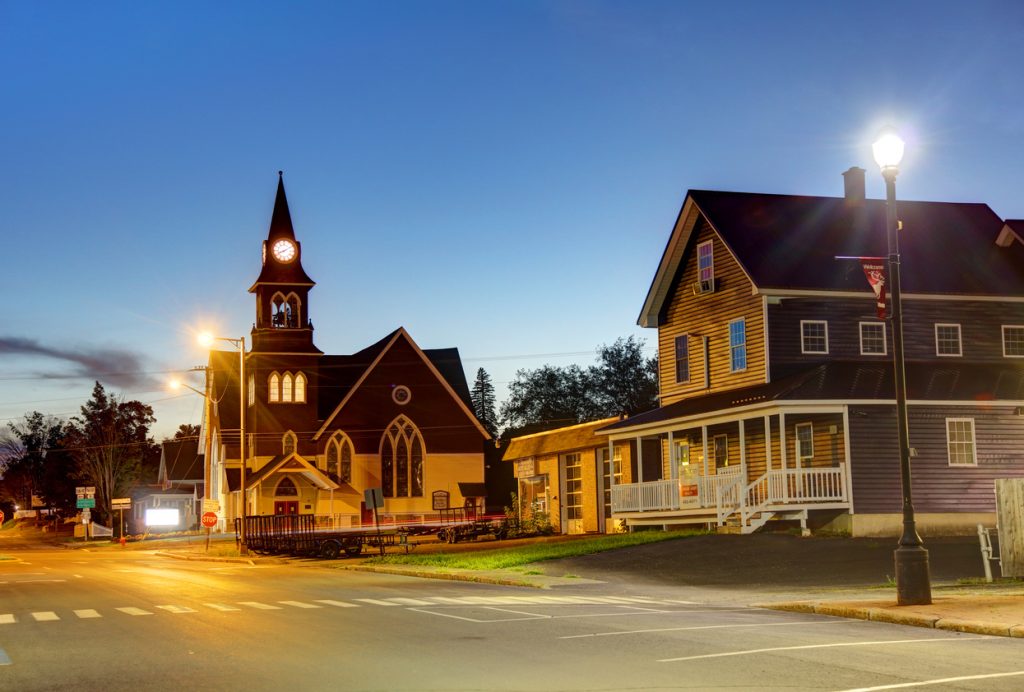
If you’re looking to be among the last in the U.S. to catch sight of the last eclipse until 2044, picking Maine as your viewing locale is the only option. The path of totality crosses the northern half of the state, with full coverage beginning in the small town of Caribou at 3:32 p.m. EDT, according to NASA. After that, the eclipse will pass through the Canadian maritime provinces before ending its traverse of North America and finishing over the Atlantic Ocean.
- Source: https://science.nasa.gov/eclipses/future-eclipses/eclipse-2024/where-when/
- Source: https://www.asc-csa.gc.ca/eng/astronomy/eclipses/total-solar-eclipse.asp
You Can See the Northern Lights in at Least 17 States Next Week—Here’s How

Sylvie Corriveau / Shutterstock
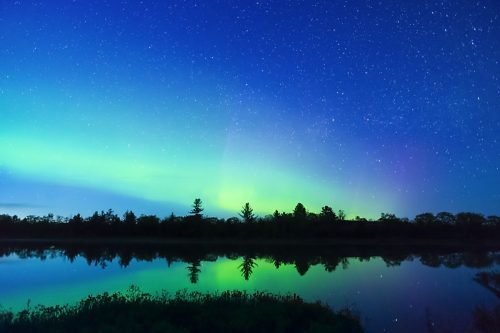
Seeing the northern lights tops many stargazers’ bucket lists for a good reason: This natural phenomenon is truly a wonder to behold. Otherwise known as the aurora borealis, these lights appear as a result of charged particles from the sun interacting with the Earth’s magnetic field , per the Library of Congress. You may be under the impression that you can only see this colorful spectacle if you venture to Alaska or Canada, but that’s not entirely true. In fact, the northern lights will be visible in at least 17 U.S. states on July 13—and potentially even more. Read on to find out where and how you can catch a glimpse.
READ THIS NEXT: 6 Stargazing Secrets, According to Astronomy Experts .
Rachel Juliet Lerch / Shutterstock
The Geophysical Institute at the University of Alaska Fairbanks is predicting high “ auroral activity ” next week, specifically on Thursday, July 13.
“Weather permitting, highly active auroral displays will be visible overhead from Inuvik, Yellowknife, Rankin and Iqaluit to Vancouver, Helena, Minneapolis, Milwaukee, Bay City, Toronto, Montpelier, and Charlottetown, and visible low on the horizon from Salem, Boise, Cheyenne, Lincoln, Indianapolis and Annapolis,” the July 13 forecast reads, citing cities in both Canada and the U.S.
As USA Today reports , in the U.S., the northern lights may be visible from Alaska, New York, New Hampshire, Maine, Washington, and South Dakota. The university cites specific cities in Maryland, Montana, Minnesota, Wisconsin, Michigan, Vermont, Massachusetts, Idaho, Wyoming, North Dakota, and Indiana.
Per the University of Alaska Fairbanks’ map, however, several other states may see the northern lights low on the horizon. These additional states include Oregon, Colorado, Kansas, Nebraska, Missouri, Ohio, West Virginia, Pennsylvania, Virginia, New Jersey, Connecticut, and Rhode Island.
m-gucci / iStock
Depending on where you live, you might get a sneak peek of the aurora borealis on Wednesday night.
Activity is also anticipated to be high on July 12, per the university’s forecast, which predicts that the lights will be visible overhead in Juneau, Alaska, and active auroral displays will be visible low on the horizon in Seattle, Chicago, Cleveland, Boston, and Des Moines, Iowa.
pamas / Shutterstock
The forecast notes that your ability to see the northern lights depends on the weather. Because you won’t be able to see the vivid green or red colors through clouds, Space.com recommends checking your local forecast before venturing out.
If the weather looks like it’s on your side, expect to see the best activity between 10 p.m. and 2 a.m. local time, per the National Oceanic and Atmospheric Administration (NOAA) Space Weather Prediction Center.
You won’t need a telescope to see the aurora borealis, but city dwellers should get away from the bright urban lights, as darkness is essential. Thankfully, the moon is in its last quarter phase next Thursday, which means that its brightness won’t play as big of a role in obstructing your view.
Shutterstock
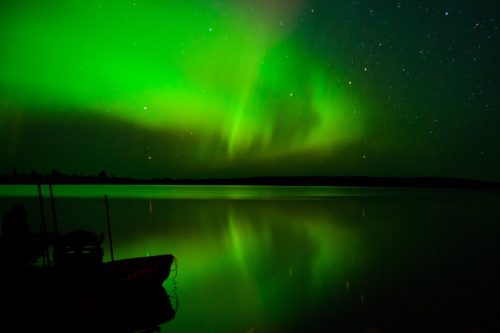
This isn’t the first time that the northern lights made an appearance over the U.S. In May, “supercharged” northern lights were anticipated, and in April, lights were visible over 30 U.S. states .
If you miss next week’s display, the University of Alaska Fairbanks assures you that experts will continue to regularly predict when and where aurora will appear—although these forecasts aren’t as reliable as your daily and weekly weather.
