The #1 Way Tariffs Are Affecting Your Mail, Says the USPS

iStock
The past few years have been relatively rocky for the U.S. Postal Service. From service changes to increased theft, the agency has struggled to overcome issues amid budget cuts and a sudden change in leadership . Of course, most customers are still concerned that the service could choose to raise prices , which is especially concerning as looming tariffs put into place by President Donald Trump threaten to raise costs on items ranging from coffee to cars. But will this change the way you send and receive packages? Now that a few notable deadlines have passed, experts say tariffs are already affecting your mail in some significant ways.
A policy change has nearly ceased incoming international mail.
A new economic reality appears to be settling in. According to the United Nations’ Universal Postal Union (UPU), inbound mail and packages on their way to the U.S. dropped 81 percent after Aug. 29 compared to the previous week, NPR reports. The drastic shift came within 24 hours of Trump’s suspension of the longstanding “de minimis” exemption for parcels that waived tariffs on any items entering the country valued at less than $800.
The change comes less than a month after Trump issued an executive order on July 30 pausing the import rule. Now, all items entering the U.S. will be subject to extra fees that vary depending on which country they’re arriving from. Tariff rates range from 10 percent for countries such as the U.K., Australia, and Chile; 25 percent for Mexico; 30 percent for China; 35 percent for Canada; and up to 50 percent for Brazil, among many others, per the BBC.
Global postal operators are pulling back from sending items stateside.
The hastiness of the changes has created confusion among couriers and logistical companies, including airlines that have said they cannot afford to take on the sudden extra costs. But even traditional shipping is being affected, with the UPU saying that 88 postal operators around the world had notified the agency they were halting “some or all postal services to the U.S. until a solution is implemented.”
This drastic change underscores the importance of the flow of cheap goods into the country and has created an impetus to get things back up and moving.
“The UPU has in its mission the responsibility to guarantee the free circulation of postal items over a single postal territory. We’re working to uphold that responsibility with the rapid development of a new technical solution that will help get mail moving to the United States again,” Masahiko Metoki , director general for the UPU, said in a statement.
RELATED: USPS Warns Mail Theft Is Rising—5 Ways to Protect Yourself .
Many imported items could become more expensive in the future.
To do this, the agency says it plans to integrate its existing Delivered Duty Paid (DDP) system into its Customs Declaration System (CDS), which will allow global postal operators to eventually address the issue. However, the new rules will upend the affordable import loophole that has made online discount retailers like Shein and Temu feasible, NPR reports.
In response, the White House cast blame on foreign postal services that it said had failed to inspect parcels that could contain counterfeit products or drugs properly, Axios reports.
“For too long, this loophole handed criminal networks a free pass to flood America with fentanyl, fake goods, and illegal shipments. Those days are over. We are securing the border, restoring fairness to trade, and protecting American families,” U.S. Customs and Border Protection Commissioner (USBCP) Rodney Scott said in a statement issued on August 29 .
There could still be some positive side effects.
Now, with the busy holiday shopping season approaching, entire shopping strategies may need to be reconsidered to stay within budget. But while it may make items more expensive, some advocates say the suspension of de minimis rules could bring some benefits.
“It’s created significant product safety concerns because low-value imports are facing minimal customs inspection, making it easier for unsafe or noncompliant product to enter the U.S. market,” Courtney Griffin , director of consumer product safety for the Consumer Federation of America, told NPR.
Besides aiming to buy domestically, Griffin adds that shoppers should be more aware of changes to shipping and return policies for online retailers they’ve frequented in the past.
See a Sticker on Your Mailbox? Don’t Touch It, USPS Says

Shutterstock
Your mailbox serves a very simple purpose: receiving mail and leaving outgoing mail for a carrier to pick up. Still, some of us enjoy sprucing up our mailboxes, adding personal flair, color, or even decals to help an otherwise standard mailbox stand out. But if you notice a paw print sticker on your mailbox that you didn’t add, don’t start peeling it off just yet—it’s likely part of a program run by the U.S. Postal Service (USPS) to help keep carriers safe. Read on to find out what these stickers mean and why you shouldn’t remove them.
RELATED: USPS Wants to Raise the Price of Your Mail Again—Here’s When It Could Happen .
Shutterstock
In 2023, more than 5,800 Postal Service workers were attacked by dogs while delivering mail, up from 5,300 in 2022, according to a USPS press release.
Larger cities had the highest numbers of attacks, with Los Angeles, Houston, Chicago, St. Louis, and Cleveland claiming the top five spots.
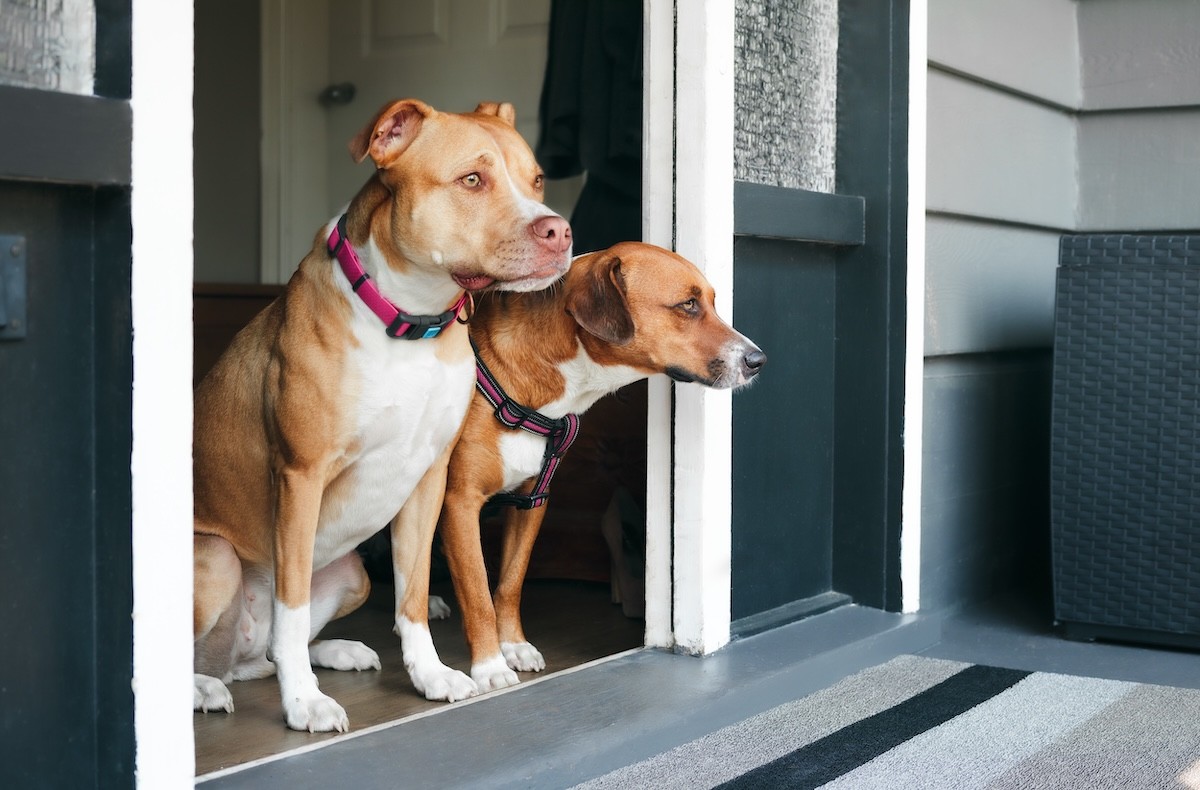
“Even though a customer’s dog is friendly to most people, it can always have a bad day,” said letter carrier Tara Snyder . “I know, from experience, even when a dog is in the house, customers need to make sure their door is secure so their dog can’t push it open and bite the letter carrier.”
To her point, the USPS writes that “all dogs can bite, even those perceived as nonaggressive.” In fact, many of the attacks that letter carriers report are by dogs whose owners told them, “My dog won’t bite.”
Such an attack can result in consequences for the homeowner, too. According to data from the Insurance Information Institute, the average cost per insurance claim for a dog bite is $64,555, the USPS states.
“When a postal employee suffers an injury, the owner could be responsible for medical bills, lost wages, uniform replacement costs, and pain and suffering for the employee,” they explain.
RELATED: USPS Is Making These Changes to Your Mail, Starting Now .
Shutterstock
To combat dog bites, the Postal Service shared tips on how pet owners can “support safe mail delivery.” These include keeping dogs inside the house or behind a fence, away from the door or in another room, or on a leash.
“Pet owners also should remind children not to take mail directly from a letter carrier as the dog may view the carrier as a threat to the child,” they state.
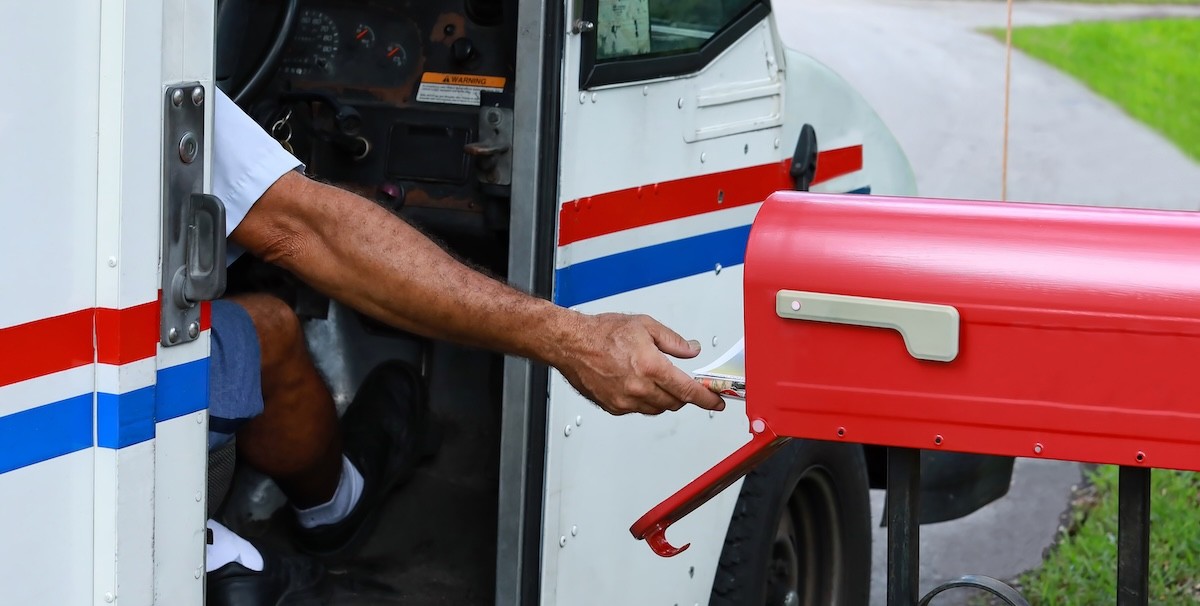
Mail carriers also follow protocol to keep them aware of areas where dogs might be present, and they’re equipped with scanners to remind them of possible dog hazards, as well as dog warning cards that are added during mail sorting.
In 2020, the USPS added another preventive measure: the PAWS Program . First introduced in Pennsylvania, the program uses mailbox stickers to keep carriers safe.

Canva
The PAWS Program uses color-coded stickers affixed to mailboxes to inform mail carriers about dogs in the area. An orange sticker with a black paw print tells carriers that there is a dog at this home, while a yellow sticker with a black paw print tells them there is a dog at the next house.
Citizens are informed ahead of time that the stickers may appear on their mailboxes. In a notice sent to Lakewood, Ohio, residents, the Postal Service wrote, “Carriers will soon be placing a paw sticker on mailboxes to indicate that a dog or dogs live in the area —yellow indicates dog nearby/orange indicates dog at residence. The sticker will act as a reminder to the carrier that they should proceed with caution, especially when delivering packages to the door.”
RELATED: Postmaster General Louis DeJoy Resigns—What It Means for the USPS and Your Mail .
iStock
Removing these stickers may do more harm than good, as your mail service can be halted if your carrier feels unsafe. Not only does this affect the home of the dog owner, but it also applies to the entire neighborhood, the USPS said in a previous press release . Service isn’t restored in these instances “until the aggressive dog is properly restrained.”
At the end of the day, these stickers are put in place to “reduce the risk of dog bites and attacks that occur while delivering mail,” which is just another reason you should leave the sticker on your mailbox.
“We all love our dogs,” Kimberly Tilley , acting postmaster for Winston-Salem, told WGHP. “We love our animals, but we … have to take responsibility to protect the carrier and the people around us as well from our animals.”
Tilley added that dog bites are more common than you think, and they can be traumatic for carriers. “Once a carrier has been bit, it sets some fear in them long term for the rest of their life,” she told the outlet.
However, although these stickers are strongly recommended, if you object to having a sticker placed on your mailbox, you can opt out , Kyle Stevens , Southwest Carrier Annex station manager in South Dakota, told KELO in 2021. To do so, the first step would be to contact your local post office.
This story has been updated to include additional entries, fact-checking, and copy-editing.
