Unexpected Package? What You Should Know About the USPS Brushing Scam
iStock
READ THIS NEXT: 6 Warnings to Customers From USPS Mail Carriers .

WOVE LOVE / shutterstock
Most everyone in the U.S. relies on the Postal Service in some capacity, so it’s no surprise the agency has often found itself at the center of major scams. These schemes usually involve fraudulent USPS texts or emails in order to steal people’s information.
For common text scams, tricksters will claim to be from the Postal Service and tell customers that there has been a problem with their shipping address, or that a package is waiting for them at the post office. Through this impersonation, the deceptive message is designed to “lure the recipient into providing their personal or financial information,” the USPS explains.
Email scams involving the USPS tend to focus on fraudulent claims about intercepted package deliveries or online postage charges, according to the agency. These fake messages “usually contain a link or attachment that, when opened, installs a malicious virus or malware that can steal personal information from the customer’s computer,” the Postal Service warns.
But some USPS scams could show up on your doorstep.
Shutterstock
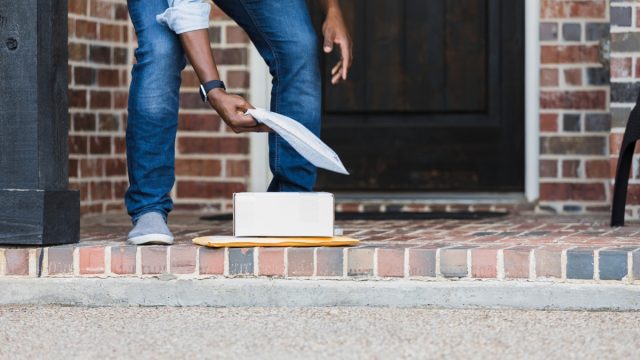
Receiving an unexpected package in the mail might not seem all that concerning—especially next to issues like impersonated texts and malicious email links. But that package may be part of another Postal Service scam, and there have been recent targets.
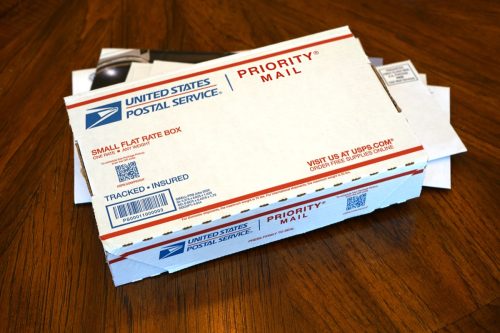
This is a telltale sign of the USPS “ brushing scam ,” according to the agency’s Postal Inspection Service (USPIS). “This is how it works: A person receives packages or parcels containing various sorts of items which were not ordered or requested by the recipient,” the USPIS explains in an alert on its website, noting that recipients may sometimes be asked to pay for the package upon arrival. “While the package may be addressed to the recipient, there is not a return address, or the return address could be that of a retailer.”

Shutterstock
If you don’t end up sending any money, you might think there’s no harm. However, you may unwittingly be part of someone else’s scheme.
“We all love surprises and gifts, but when these seemingly harmless free items come from a company or retailer, they may come with a higher cost than you realize,” the USPIS warns. According to the inspection branch, the sender in a brushing scam is usually a scammer who is using you to convince others to buy worthless junk.
“The intention is to give the impression that the recipient is a verified buyer who has written positive online reviews of the merchandise, meaning: they write a fake review in your name,” the USPIS explains. “These fake reviews help to fraudulently boost or inflate the products’ ratings and sales numbers, which they hope results in an increase of actual sales in the long-run. Since the merchandise is usually cheap and low-cost to ship, the scammers perceive this as a profitable pay-off.”

iStock
It’s not just other people that could be affected by this scheme, however. If you’ve been targeted by the brushing scam, you’re already a scammer target. Because in order to send you something you didn’t order, the scammer probably found your address online.
“While it may appear to be a victimless crime—you did after all get some free stuff—the reality is that your personal information may be compromised,” the USPIS explains. “Often scammers obtain personal information through nefarious means and with ill-intentions, and use it for a number of scams and other illicit activities in the future.”
You should act immediately to keep your personal information safe if you find yourself at the receiving end of a brushing scam. Since you’ve likely already been compromised, the USPIS says you should change your account passwords immediately. Afterwards, “closely monitor your credit reports and credit card bills,” the USPIS recommends.
As for the package, that’s up to you. You can return it to the sender if there’s a return address, throw it away, or even keep it. “If you opened it and you like it, you may keep it,” the USPIS notes. “By law, you may keep unsolicited merchandise and are under no obligation to pay for it.”
