USPS Is Planning New Changes to Your Mail, Starting Jan. 1
iStock
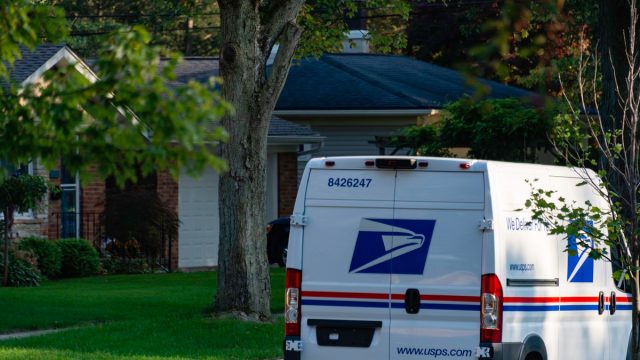
Over the past few years, the U.S. Postal Service (USPS) has been busy working to pull itself out of financial ruin. In 2021, the agency introduced its Delivering for America (DFA) initiative, which is a 10-year plan dedicated to getting the Postal Service back on track. As part of this transformation, customers have already been hit with multiple changes in the last two years—most notably the constant increase in mail prices . But now, the Postal Service is planning new adjustments to offset a decline in mail volume that could bring costs back down for certain customers. Read on to find out more about the USPS changes expected for next year.
RELATED: USPS Is Making These Changes to Your Mail, Starting Now .
iStock
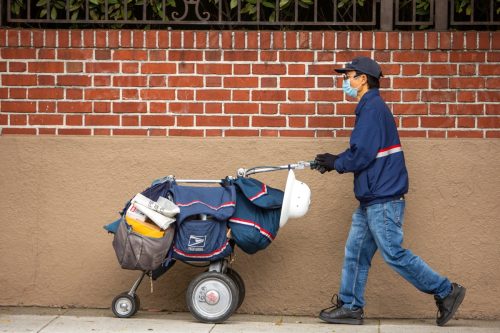
In an Aug. 8 press release , the USPS announced its results for the third quarter of the 2023 fiscal year (which ended June 30), and one of the biggest areas of concern was the Postal Service’s drop in mail volume.
According to the report, First-Class Mail volume declined by 678 million pieces, or 5.9 percent, compared to the same time period last year. Meanwhile, Marketing Mail volume fell by a staggering 2.6 billion pieces, or 16 percent.
“The Marketing Mail decreases were driven by the continued decline in advertising spending due to economic pressures experienced throughout most of the fiscal year, a higher inflationary environment affecting print media production costs, and lower political and election mail revenue and volume, compared to the same quarter last year, due to the timing of elections,” the agency stated in its release.
RELATED: USPS Just Issued a New Warning About Mailing Cash .
iStock
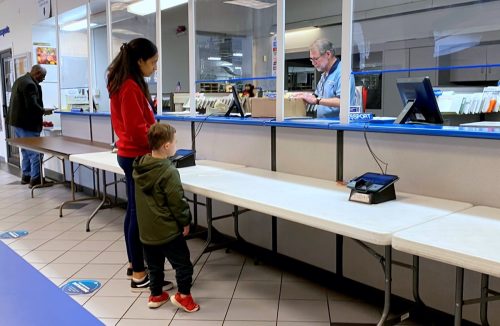
This isn’t a new problem for the USPS, however. The Postal Service was designed to be financially self-sufficient, but its business model broke about 15 years ago, Discourse Magazine reported.
After peaking at 213 billion pieces in 2006, the agency’s mail volume started plummeting, and it hasn’t stopped since. First-Class Mail has been hit the worst—dropping 53 percent from 103 billion in 2001 to just 48.9 billion in 2022, according to the news outlet.
In a May Congressional hearing , Postmaster General Louis DeJoy said the sharp decline in mail volume over the last decade and a half has “severely impacted” the agency’s finances, efficiency, and effectiveness. The fall in First-Class Mail volume has been the “most concerning,” because it is responsible for providing the greatest contribution toward covering the costs of the Postal Service’s network, according to DeJoy.
“At the same time, our cost to deliver mail continuously increased as our mail volume and revenue declined. This was driven by increased demand on our network, including the number of delivery points we serve, which had grown, and continues to grow, on average by more than one million delivery points each year,” he said. “Simply put, we were delivering less mail to more delivery points each year, which meant less revenue to cover increasing costs each year.”
RELATED: See a Sticker on Your Mailbox? Don’t Touch It, USPS Says .
iStock
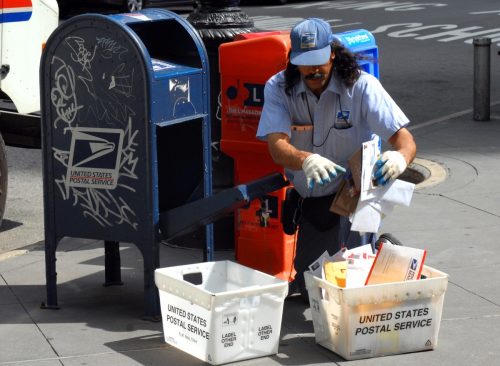
During the hearing, DeJoy told officials that these trends are expected to continue throughout the next decade—with a 36 percent total decline in mail volume projected by the 2030 fiscal year. In an attempt to offset this, the USPS is “launching a new initiative to address declines in mail volume,” the Federal News Network reported.
In an Aug. 11 press release , the Postal Service announced that it had filed notice with the Postal Regulatory Commission (PRC) of proposed plans to make certain Mail Classification Schedule (MCS) changes. These adjustments will allow the USPS to establish two new mail growth incentives: a First-Class Mail Growth Incentive and a Marketing Mail Growth Incentive.
“These two incentives will drive mail owners to increase the volume of First-Class and Marketing mail entering the network while providing them lower overall postage costs on incremental growth—allowing mail owners to maximize total return on investment, by providing additional cost-savings and strengthening the value of mail,” the agency said in its release.
Shutterstock
These changes are aimed at large mailers to help increase the amount of mail the USPS delivers after years of decline, Federal News Network explained. If approved by the PRC, the incentives will run from Jan. 1, 2024 to Dec. 31, 2024.
During this time, mail owners will have the opportunity to receive postage credits for helping grow First-Class Mail and Marketing Mail volumes beyond baselines, according to a separate Industry Alert from the Postal Service.
“Among the requirements to be eligible to claim the postage credits in each of these incentives, a mail owner must register for the incentive… mail at least one million qualifying pieces in calendar year (CY) 2024, and (C) mail more qualifying pieces in CY 2024 than they mailed in fiscal year (FY) 2023,” the USPS said it its alert. “Mail owners can participate in either or both Mail Growth Incentives, but the incentives cannot be combined for the purposes of reaching the million-piece minimums or for any other purpose. ”
As long as the incentives are approved by the PRC, the agency is planning to start registration for customers interested in taking part in November.
“Postage credits will be issued to qualified mail owners after six months, nine months, and twelve months from the start of CY 2024 and will be able to be used on future mailings until December 31, 2025,” the USPS stated.
- Source: https://about.usps.com/newsroom/national-releases/2023/0808-usps-reports-third-quarter-fiscal-year-2023-results.htm
- Source: https://about.usps.com/newsroom/testimony-speeches/pdf/051723.pdf
- Source: https://about.usps.com/newsroom/national-releases/2023/0811-usps-files-with-prc-to-establish-mail-growth-incentives.htm
- Source: https://postalpro.usps.com/node/12375
See a Sticker on Your Mailbox? Don’t Touch It, USPS Says

Shutterstock
Your mailbox serves a very simple purpose: receiving mail and leaving outgoing mail for a carrier to pick up. Still, some of us enjoy sprucing up our mailboxes, adding personal flair, color, or even decals to help an otherwise standard mailbox stand out. But if you notice a paw print sticker on your mailbox that you didn’t add, don’t start peeling it off just yet—it’s likely part of a program run by the U.S. Postal Service (USPS) to help keep carriers safe. Read on to find out what these stickers mean and why you shouldn’t remove them.
RELATED: USPS Wants to Raise the Price of Your Mail Again—Here’s When It Could Happen .
Shutterstock
In 2023, more than 5,800 Postal Service workers were attacked by dogs while delivering mail, up from 5,300 in 2022, according to a USPS press release.
Larger cities had the highest numbers of attacks, with Los Angeles, Houston, Chicago, St. Louis, and Cleveland claiming the top five spots.
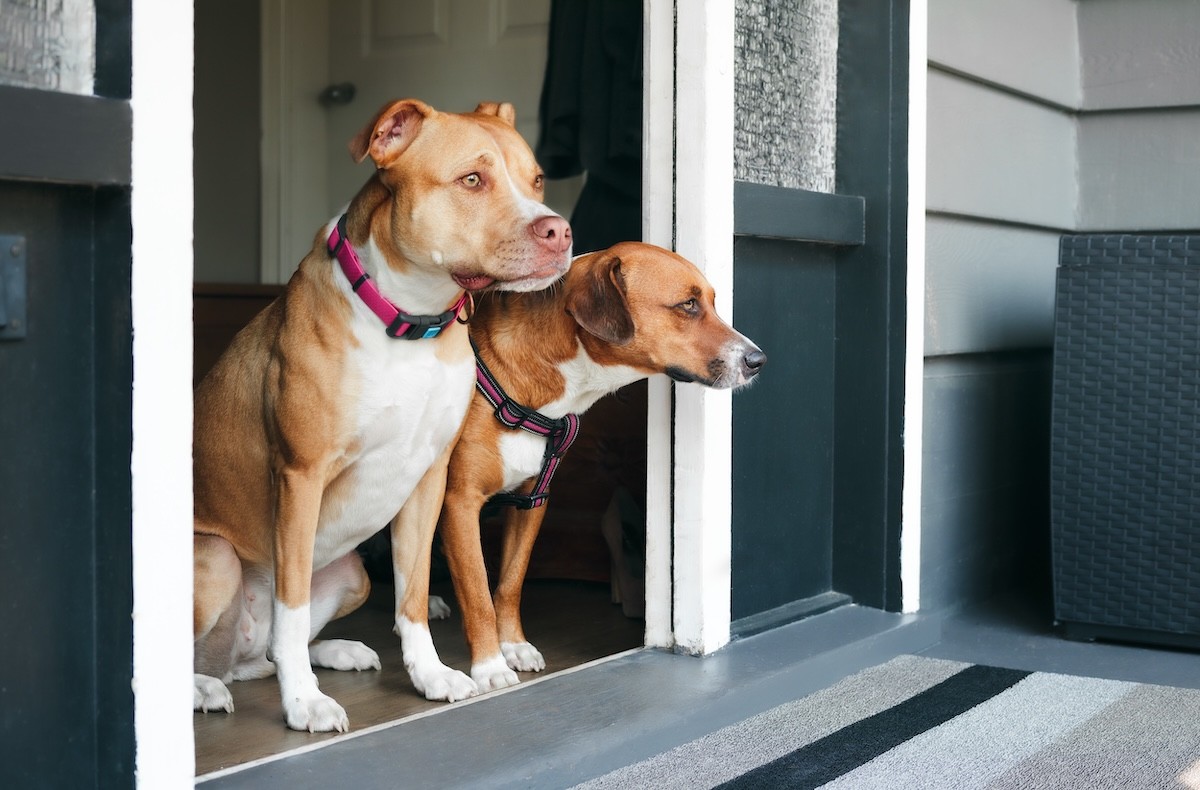
“Even though a customer’s dog is friendly to most people, it can always have a bad day,” said letter carrier Tara Snyder . “I know, from experience, even when a dog is in the house, customers need to make sure their door is secure so their dog can’t push it open and bite the letter carrier.”
To her point, the USPS writes that “all dogs can bite, even those perceived as nonaggressive.” In fact, many of the attacks that letter carriers report are by dogs whose owners told them, “My dog won’t bite.”
Such an attack can result in consequences for the homeowner, too. According to data from the Insurance Information Institute, the average cost per insurance claim for a dog bite is $64,555, the USPS states.
“When a postal employee suffers an injury, the owner could be responsible for medical bills, lost wages, uniform replacement costs, and pain and suffering for the employee,” they explain.
RELATED: USPS Is Making These Changes to Your Mail, Starting Now .
Shutterstock
To combat dog bites, the Postal Service shared tips on how pet owners can “support safe mail delivery.” These include keeping dogs inside the house or behind a fence, away from the door or in another room, or on a leash.
“Pet owners also should remind children not to take mail directly from a letter carrier as the dog may view the carrier as a threat to the child,” they state.
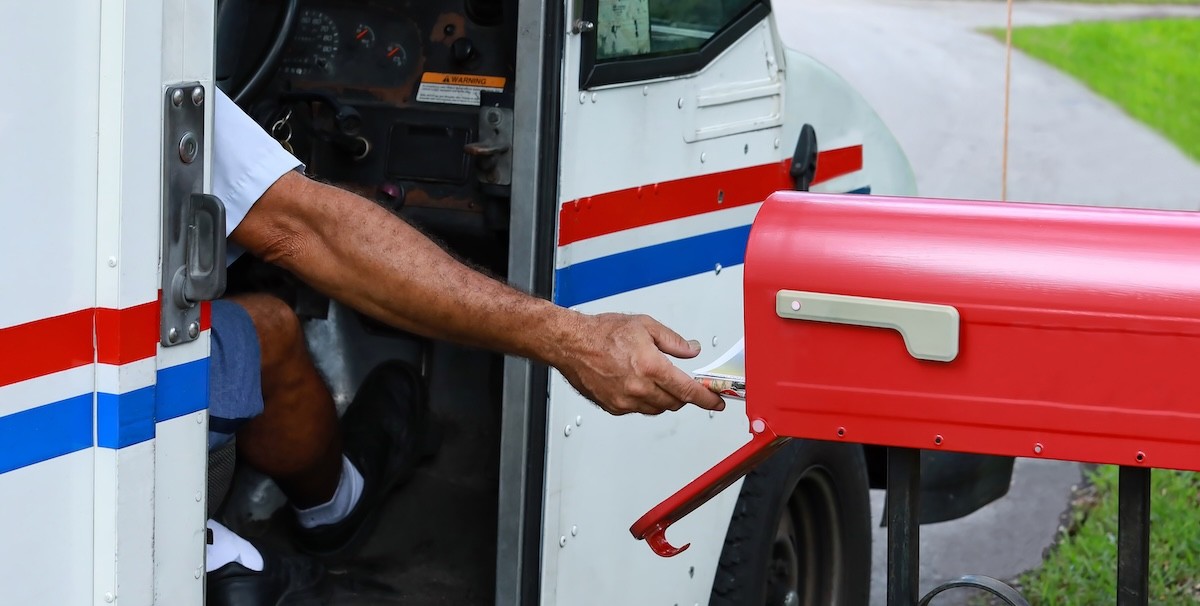
Mail carriers also follow protocol to keep them aware of areas where dogs might be present, and they’re equipped with scanners to remind them of possible dog hazards, as well as dog warning cards that are added during mail sorting.
In 2020, the USPS added another preventive measure: the PAWS Program . First introduced in Pennsylvania, the program uses mailbox stickers to keep carriers safe.

Canva
The PAWS Program uses color-coded stickers affixed to mailboxes to inform mail carriers about dogs in the area. An orange sticker with a black paw print tells carriers that there is a dog at this home, while a yellow sticker with a black paw print tells them there is a dog at the next house.
Citizens are informed ahead of time that the stickers may appear on their mailboxes. In a notice sent to Lakewood, Ohio, residents, the Postal Service wrote, “Carriers will soon be placing a paw sticker on mailboxes to indicate that a dog or dogs live in the area —yellow indicates dog nearby/orange indicates dog at residence. The sticker will act as a reminder to the carrier that they should proceed with caution, especially when delivering packages to the door.”
RELATED: Postmaster General Louis DeJoy Resigns—What It Means for the USPS and Your Mail .
iStock
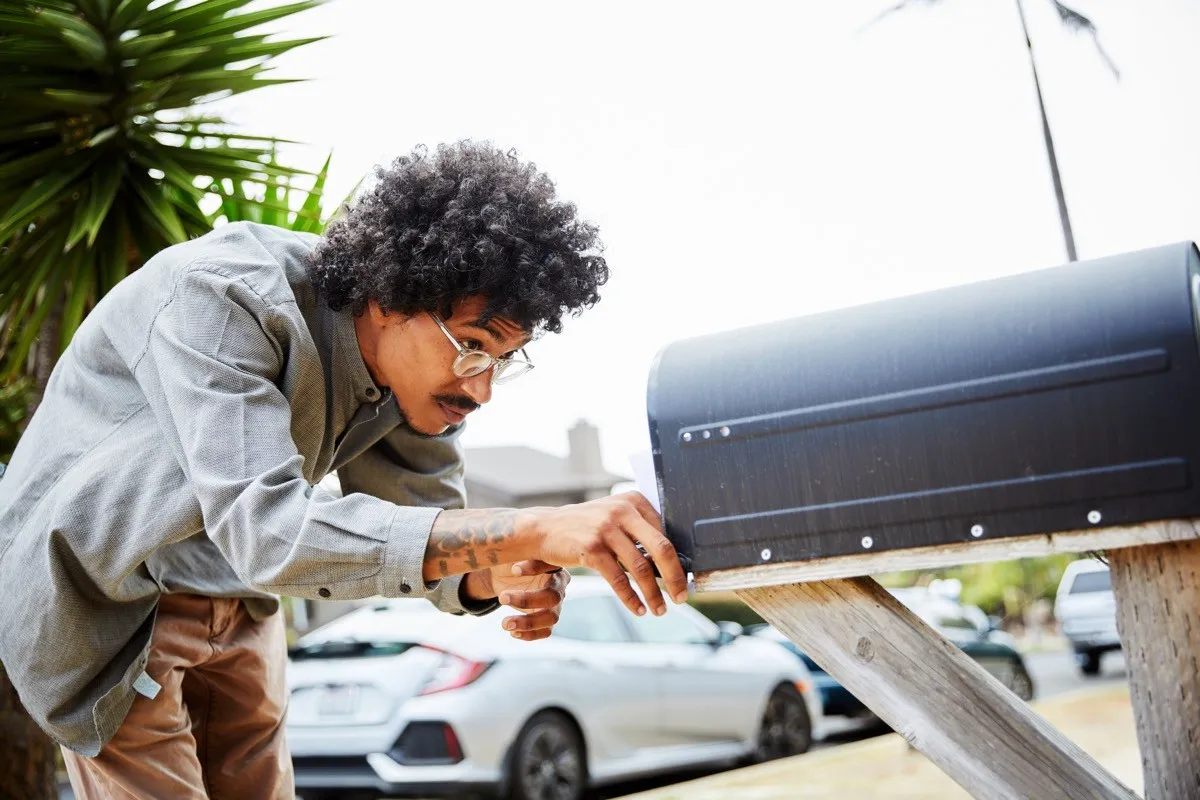
Removing these stickers may do more harm than good, as your mail service can be halted if your carrier feels unsafe. Not only does this affect the home of the dog owner, but it also applies to the entire neighborhood, the USPS said in a previous press release . Service isn’t restored in these instances “until the aggressive dog is properly restrained.”
At the end of the day, these stickers are put in place to “reduce the risk of dog bites and attacks that occur while delivering mail,” which is just another reason you should leave the sticker on your mailbox.
“We all love our dogs,” Kimberly Tilley , acting postmaster for Winston-Salem, told WGHP. “We love our animals, but we … have to take responsibility to protect the carrier and the people around us as well from our animals.”
Tilley added that dog bites are more common than you think, and they can be traumatic for carriers. “Once a carrier has been bit, it sets some fear in them long term for the rest of their life,” she told the outlet.
However, although these stickers are strongly recommended, if you object to having a sticker placed on your mailbox, you can opt out , Kyle Stevens , Southwest Carrier Annex station manager in South Dakota, told KELO in 2021. To do so, the first step would be to contact your local post office.
This story has been updated to include additional entries, fact-checking, and copy-editing.
