USPS Postal Inspector Reveals How to Prevent Identity Theft
iStock
We trust the U.S. Postal Service (USPS) with a lot of important things, including letters to loved ones and sensitive financial information. But one circulating text scam involving the USPS could put your private data into less trustworthy hands—allowing criminals to use it to steal your money or open fraudulent accounts in your name. To avoid this, scam experts are warning about what to be on the lookout for, and how you can avoid getting tricked. Read on to discover how USPS postal inspectors say you can prevent identity theft.
RELATED: USPS Postal Inspector Reveals How to Mail Checks to Avoid Theft .

ponsulak / Shutterstock
Have you received a text about your USPS package being stuck in a warehouse? You’re not alone.
Over the past few months, countless people have taken to social media to share similar texts they’ve been sent concerning delivery problems.
“I recently received a text saying a USPS package arrived at the warehouse but was undeliverable due to incomplete address. It then provided a link to fill out,” one user posted to X on Aug. 23.
Another person shared nearly the same story a few days earlier, in an Aug. 14 Reddit post . “I got a text saying USPS failed to deliver my package and saying to confirm my address at a link,” they wrote.
The incidents go back several months. A different Reddit user posted about the same warehouse message in a June 14 thread , asking, “Does USPS send these kind of texts?”
RELATED: USPS Just Issued a New Warning About Mailing Cash .
iStock
No, the Postal Service doesn’t send these kind of texts. In an Aug. 28 interview with Missouri-based KY3, USPS Postal Inspector Paul Shade said that the warehouse text is a scam that could cost people their identity and money.
“These scams are often an attempt to impersonate a government agency or bank in order to lend legitimacy to their claims,” Shade told the news outlet.
According to Malware Tips, this specific scam prompts victims to click a link to confirm personal details in order to get their package shipped. The link in the text directs you to a fake USPS website designed to steal whatever data you enter—and these criminals are looking for your personal or financial information, the U.S. Postal Inspection Service (USPIS) warns on its website .
“The criminals want to receive personally identifiable information (PII) about the victim such as: account usernames and passwords, Social Security number, date of birth, credit and debit card numbers, personal identification numbers (PINs), or other sensitive information,” the USPIS explains. “This information is used to carry out other crimes, such as financial fraud.”
RELATED: USPS Issues New Warning About Mailing Checks After Victims Lose Thousands .
iStock
This specific USPS scam has “already resulted in thousands of cases of identity theft and severe financial consequences,” Malware Tips reported. The most important protective measure you can employ is knowing exactly how the agency will contact you.
If there’s a problem delivering a package, Shade told KY3 that customers will receive a physical letter about it.
“We have thousands and thousands of carriers out there, and they would leave a notification on your door if that were the case,” he said.
It is possible to receive texts from the USPS, Shade noted—but you have to be the one to initiate it.
“The only time you are going to receive any correspondence via text from the Postal Service is if you have signed up for it,” Shade told KY3. “You won’t receive anything unsolicited from the Postal Service. So, you have to opt in.”
On its website, the USPIS confirms that customers can prevent identity theft by remembering this. “Never give personal information over the phone or internet unless you initiated the contact,” the agency advises.
RELATED: See a Sticker on Your Mailbox? Don’t Touch It, USPS Says .
iStock
When Best Life reached out to the USPS about the warehouse text scam, postal inspector Michael Martel confirmed that the agency does offer free tools to track packages. If there’s an issue with your delivery, you may be notified about it via text, but only if you’ve signed up for notifications.
“Customers are required to either register online, or initiate a text message, and provide a tracking number,” he said.
Martel said there are two other red flags customers can look out for as well: payment requests and unsolicited links.
“USPS does not charge for these services,” he noted. Also, the agency “will not send customers text messages or e-mails without a customer first requesting the service with a tracking number, and it will not contain a link.”
Martel concluded, “So, if you did not initiate the tracking request for a specific package directly from USPS and it contains a link: don’t click the link.”

iStock
If you’ve received one of these warehouse texts, don’t just delete it. Instead, Martel said that customers should report USPS-related smishing scams like this to the agency’s inspection branch. You can do this by sending an email to [email protected] .
“Without clicking on the web link, copy the body of the suspicious text message and paste into a new email,” he explained. “Provide your name in the email, and attach a screenshot of the text message showing the phone number of the sender and the date sent.”
Martel advised people to also include “any relevant details” in their email, like whether or not you clicked the link, lost money, provided any personal information, or experienced any impacts to your credit or identity.
“The Postal Inspection Service will contact you if more information is needed,” he said.
- Source: https://www.uspis.gov/news/scam-article/smishing-package-tracking-text-scams
- Source: https://www.uspis.gov/tips-prevention/identity-theft
See a Sticker on Your Mailbox? Don’t Touch It, USPS Says

Shutterstock
Your mailbox serves a very simple purpose: receiving mail and leaving outgoing mail for a carrier to pick up. Still, some of us enjoy sprucing up our mailboxes, adding personal flair, color, or even decals to help an otherwise standard mailbox stand out. But if you notice a paw print sticker on your mailbox that you didn’t add, don’t start peeling it off just yet—it’s likely part of a program run by the U.S. Postal Service (USPS) to help keep carriers safe. Read on to find out what these stickers mean and why you shouldn’t remove them.
RELATED: USPS Wants to Raise the Price of Your Mail Again—Here’s When It Could Happen .
Shutterstock
In 2023, more than 5,800 Postal Service workers were attacked by dogs while delivering mail, up from 5,300 in 2022, according to a USPS press release.
Larger cities had the highest numbers of attacks, with Los Angeles, Houston, Chicago, St. Louis, and Cleveland claiming the top five spots.
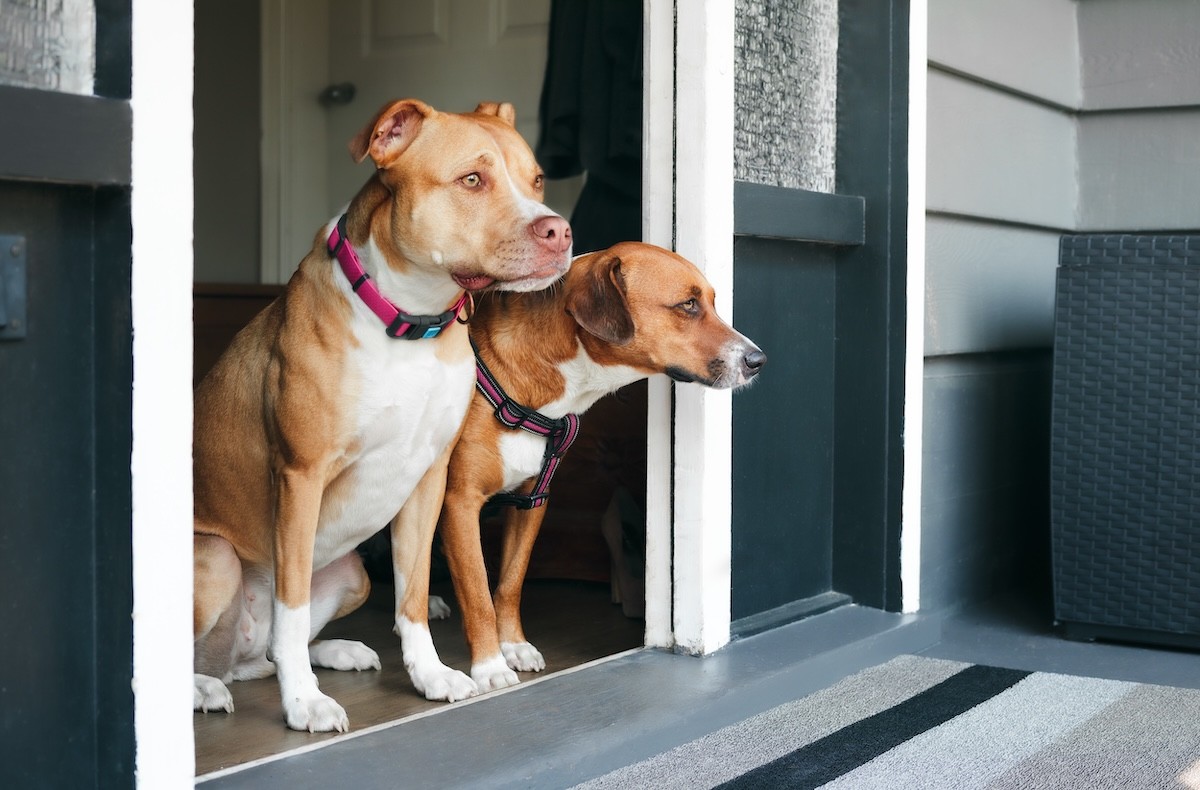
“Even though a customer’s dog is friendly to most people, it can always have a bad day,” said letter carrier Tara Snyder . “I know, from experience, even when a dog is in the house, customers need to make sure their door is secure so their dog can’t push it open and bite the letter carrier.”
To her point, the USPS writes that “all dogs can bite, even those perceived as nonaggressive.” In fact, many of the attacks that letter carriers report are by dogs whose owners told them, “My dog won’t bite.”
Such an attack can result in consequences for the homeowner, too. According to data from the Insurance Information Institute, the average cost per insurance claim for a dog bite is $64,555, the USPS states.
“When a postal employee suffers an injury, the owner could be responsible for medical bills, lost wages, uniform replacement costs, and pain and suffering for the employee,” they explain.
RELATED: USPS Is Making These Changes to Your Mail, Starting Now .
Shutterstock
To combat dog bites, the Postal Service shared tips on how pet owners can “support safe mail delivery.” These include keeping dogs inside the house or behind a fence, away from the door or in another room, or on a leash.
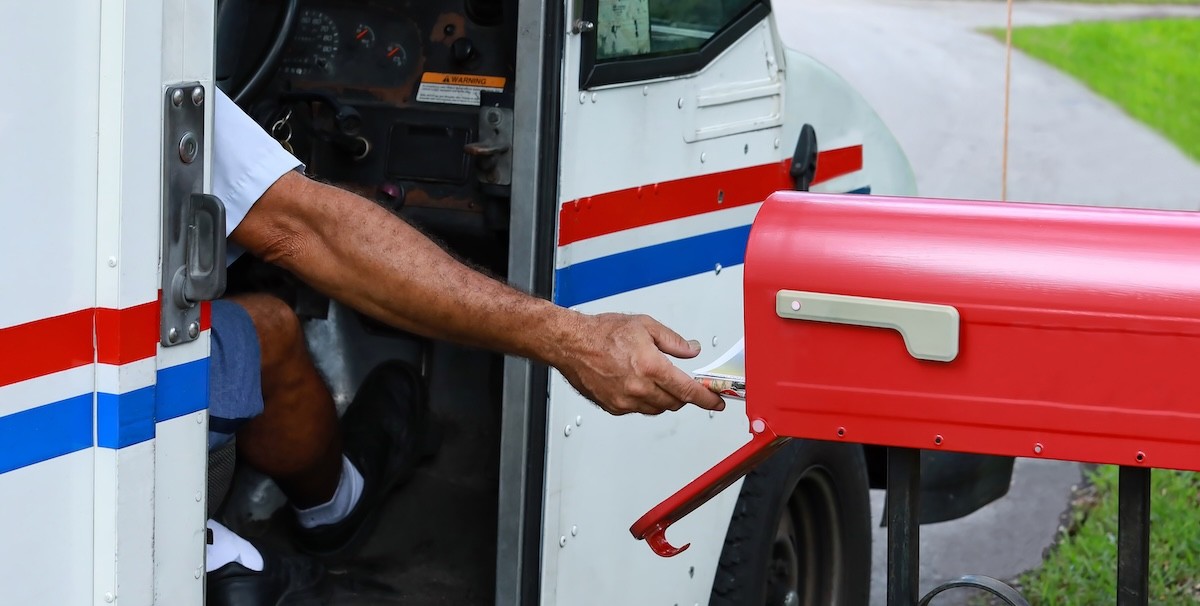
“Pet owners also should remind children not to take mail directly from a letter carrier as the dog may view the carrier as a threat to the child,” they state.
Mail carriers also follow protocol to keep them aware of areas where dogs might be present, and they’re equipped with scanners to remind them of possible dog hazards, as well as dog warning cards that are added during mail sorting.
In 2020, the USPS added another preventive measure: the PAWS Program . First introduced in Pennsylvania, the program uses mailbox stickers to keep carriers safe.

Canva
The PAWS Program uses color-coded stickers affixed to mailboxes to inform mail carriers about dogs in the area. An orange sticker with a black paw print tells carriers that there is a dog at this home, while a yellow sticker with a black paw print tells them there is a dog at the next house.
Citizens are informed ahead of time that the stickers may appear on their mailboxes. In a notice sent to Lakewood, Ohio, residents, the Postal Service wrote, “Carriers will soon be placing a paw sticker on mailboxes to indicate that a dog or dogs live in the area —yellow indicates dog nearby/orange indicates dog at residence. The sticker will act as a reminder to the carrier that they should proceed with caution, especially when delivering packages to the door.”
RELATED: Postmaster General Louis DeJoy Resigns—What It Means for the USPS and Your Mail .
iStock
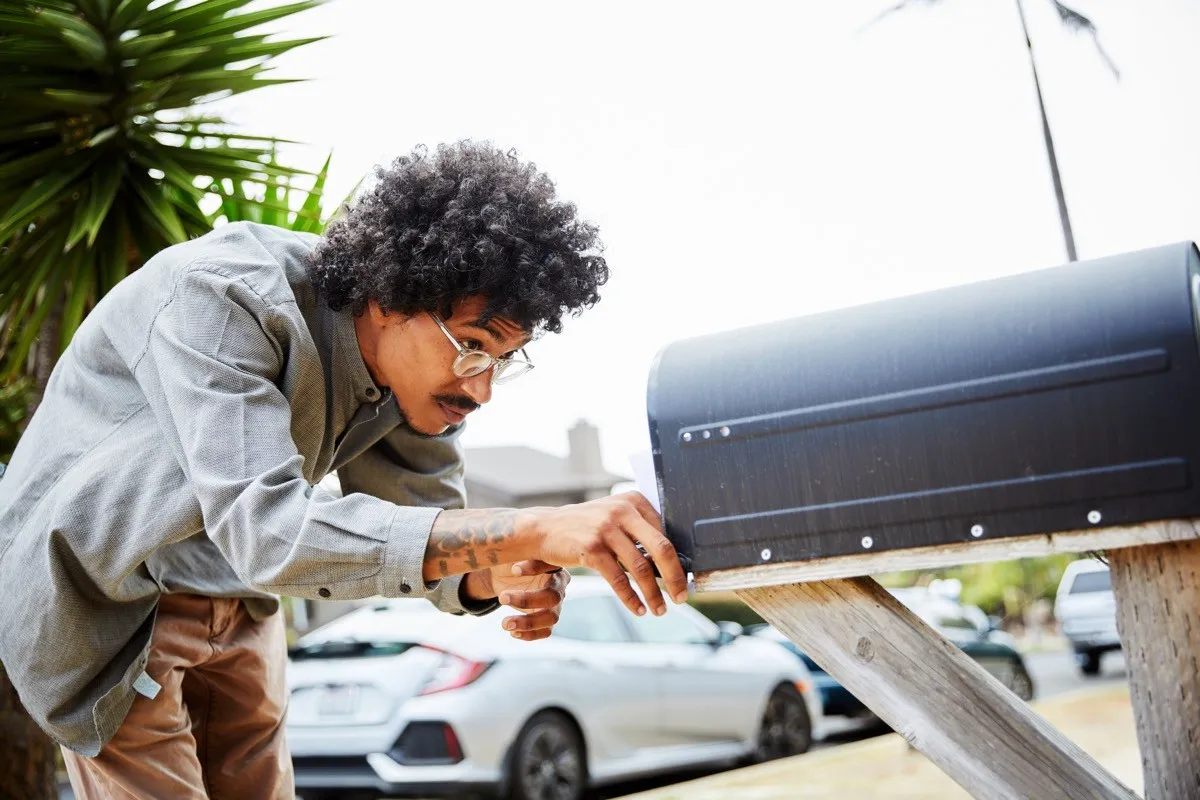
Removing these stickers may do more harm than good, as your mail service can be halted if your carrier feels unsafe. Not only does this affect the home of the dog owner, but it also applies to the entire neighborhood, the USPS said in a previous press release . Service isn’t restored in these instances “until the aggressive dog is properly restrained.”
At the end of the day, these stickers are put in place to “reduce the risk of dog bites and attacks that occur while delivering mail,” which is just another reason you should leave the sticker on your mailbox.
“We all love our dogs,” Kimberly Tilley , acting postmaster for Winston-Salem, told WGHP. “We love our animals, but we … have to take responsibility to protect the carrier and the people around us as well from our animals.”
Tilley added that dog bites are more common than you think, and they can be traumatic for carriers. “Once a carrier has been bit, it sets some fear in them long term for the rest of their life,” she told the outlet.
However, although these stickers are strongly recommended, if you object to having a sticker placed on your mailbox, you can opt out , Kyle Stevens , Southwest Carrier Annex station manager in South Dakota, told KELO in 2021. To do so, the first step would be to contact your local post office.
This story has been updated to include additional entries, fact-checking, and copy-editing.
